Effort Pays Off — and Kids Decide What It Buys
Not from lectures — from earning Kudo Coins for real effort and deciding what to do with them. Every price in the store is shown in about how many days of routines it costs, so the math is theirs to do.

Not from lectures — from earning Kudo Coins for real effort and deciding what to do with them. Every price in the store is shown in about how many days of routines it costs, so the math is theirs to do.

Bribery is money handed over to stop a moment. This is the opposite shape: the work comes first, the price is public, waiting is worth more than spending, and a parent signs off on both ends. Kids end up practicing the decisions adults make with a paycheck.
Coins don't arrive on a schedule — they arrive when something gets finished. Tasks pay what you decided they pay, securing the day's streak adds a bonus on top, and finished learning games pay up to a coin each, up to a daily limit. Whatever ends up in the store window, there's effort behind the balance that reaches it.
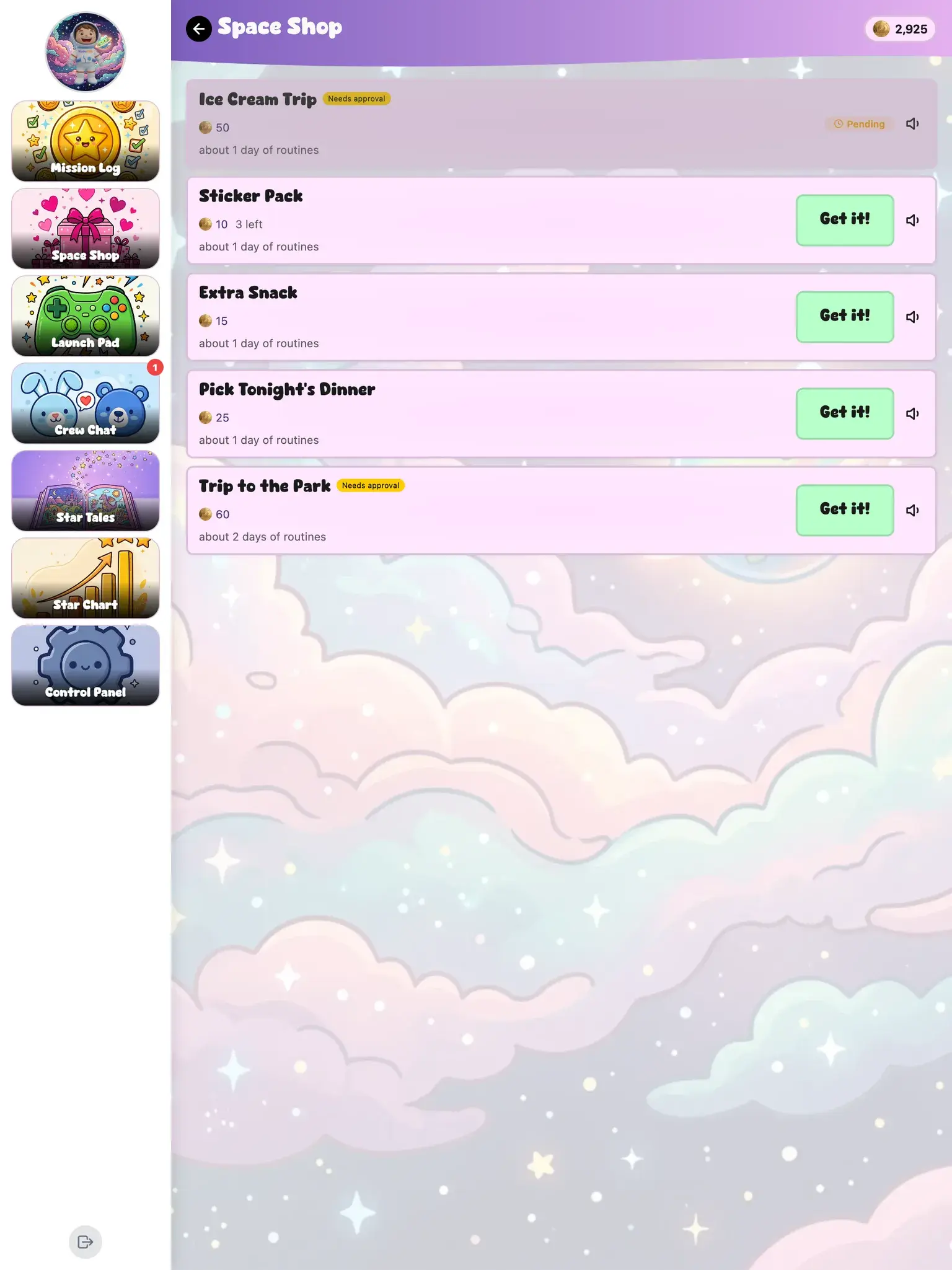
Every reward shows its coin price and, underneath, about how many days of routines it costs — "about 1 day," "about 2 days." A seven-year-old can't price 60 coins. They can absolutely price two days of getting up and doing their list, and that's the number that changes what they pick.
You control the coin value of every task and the price of everything in the store. Savings withdrawals, and redemptions of the rewards you mark as needing your OK, land in your Inbox for a yes or no. A child can't buy anything with real money anywhere in KudoKids — the only currency they hold is the one they earned.
Ethan is 7. He picked the Space Adventure world and instantly fell in love with Cosmo’s Gold look. The store says it costs about a week of routines. That feels like a lot — and it’s the first time a price has meant anything real to him.
His mom set every coin value herself. Brushing teeth is 2. Making his bed is 5. Setting the table is 8, because in their house that’s the one nobody wants. A perfect day comes to 37 coins, and securing the streak adds a little on top.
Days 1 through 3 he doesn’t miss a thing. Day 4 he forgets to make his bed and skips reading — 10 coins he doesn’t earn, and he knows exactly what it cost him, because he can see the goal getting a day further away. Day 5 is a Saturday: he sleeps in, but feeds the dog and helps wipe the table.
Somewhere in there he does something his mom didn’t teach him. There’s a sticker pack for 10 coins sitting right there, about a day of routines, and he doesn’t buy it. A week and a half in, the balance is there. He opens the store and buys the Gold look.
That’s the whole lesson, and it isn’t a lesson — it’s a trade he made himself. Something cost more than he had, so he waited, gave up smaller things on the way, and got it. Most adults are still working on that one.
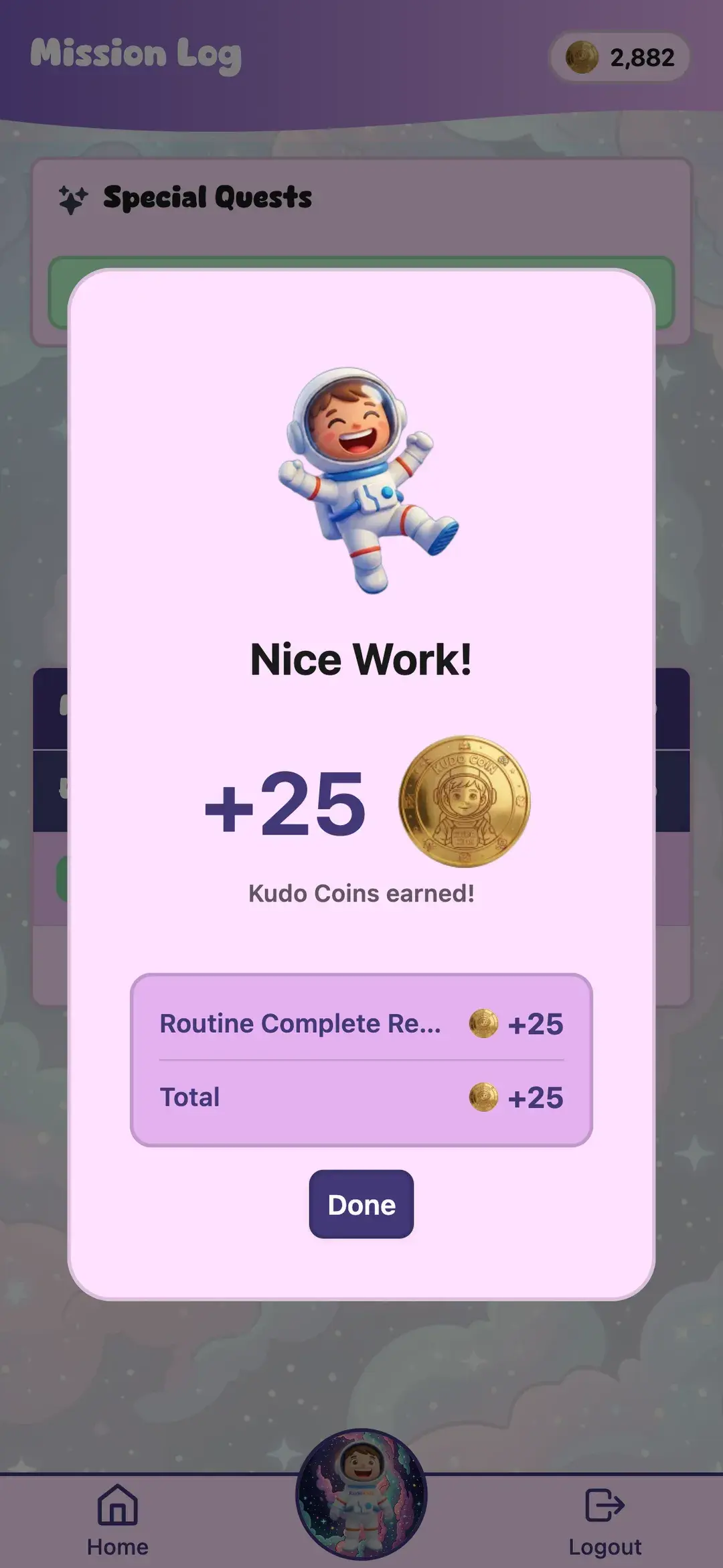
Finished tasks pay out at the value you gave them, and you can override a value for one child without changing it for their siblings. Finish every routine in a day and the streak is secured, which adds a bonus that grows the longer the run holds. Finished learning games pay up to a coin each, up to a daily limit you set. One-time bonus tasks cover the things that don't repeat — a book report, helping a neighbor.
How those routines get built, and how they keep running without you chasing them, is the other half of this loop — that lives on responsibility.
Stock the store with whatever actually motivates your child. Real-life rewards like a trip to the park, an extra snack, or choosing tonight's dinner. In-app rewards like companion looks, world music, and extras. You decide what each one costs; they decide what to save for. You can cap how many times something can be redeemed, so “3 left” is a real limit rather than a bluff. And a Family Bucket reward lets everyone chip in toward one shared goal — the pizza night or the zoo trip the whole crew is earning together.
A coin number on its own teaches nothing — a child has no sense of whether 60 is a lot. So under every price, the store does the conversion for them: about how many days of their own routines that reward costs, calculated from what they actually earn. Suddenly the comparison is between two real things: this reward, or two mornings of effort. That's the arithmetic that makes a kid stop and think, and it's the one that carries over to money later.
The same idea works away from the screen, too: teaching kids about money before they have any.
Wanting something you can't have yet is the hardest feeling a seven-year-old handles all week. KudoKids gives it somewhere to go: your child can commit coins toward a savings goal and watch the progress bar fill instead of spending on the first thing they see. Leaving the money alone pays a save-up bonus, so patience has a number attached to it rather than just being something you tell them to have. If they want to pull out early, they can ask — the withdrawal goes to your Inbox, and the conversation about whether it's worth it happens before the coins move, not after.
For kids six and up, a gentle Saving Helper sets a small weekly saving target sized to what they actually earn — hit it and next week's grows a little; miss it and nothing happens. It never takes coins and never blocks a purchase, and an older kid can even switch it off themselves (you'll get a heads-up if they do).
Kudo Coins are tracked through a transaction history that can't be rewritten, just like a real account. Your child sees their balance grow when they finish their routines and shrink when they redeem rewards, and they can filter the history by earned and spent to see where it all went. Over time they start running the same calculation adults run: is this worth it, or should I save for something bigger?
If a credit lands that shouldn't have — the task didn't need your OK and wasn't really done — you post a correcting adjustment rather than deleting anything. Both entries stay visible. Your child learns what a correction is by seeing one, which is roughly how a bank statement teaches it too.
A correction fixes the record rather than punishing anyone. Consequences are a separate question, and we look at whether behavior points and demerits help kids.
Every reward you stock can be marked as needing approval. When your child redeems one, it doesn't just happen — it lands in your Inbox marked pending, alongside savings withdrawals and everything else waiting on you. One tap releases it. One tap sends it back. Your child sees the pending state on their own screen, so the wait is visible rather than a mystery.
And the ceiling on all of it is fixed: there is no path anywhere in KudoKids for a child to spend real money. Kudo Coins are the only currency they hold, and they earned every one.
Shaped by Practitioners
The Kudo Coin system is designed around effort-based praise and reward-based learning. KudoKids has been shaped by working with child-development experts. These practitioners have not endorsed KudoKids; our design is informed by their input, not validated by it.
Learn about our approach →
Your rewards, your prices, your approval — and kids who earned every coin they spend.
No credit card required. Set up in five minutes.