The Short Answer
Start around 3, before your child has any cash. Let them hand over real coins, say prices out loud, and practice short waits. Around 5 or 6, start a small weekly allowance. Scholastic's guide is 50 cents to $1 per week for each year of age. Pair it with a saving goal they can see fill up.
Why Teach Money Before Kids Have Money?
Kids start learning the basic ideas about money years before they have any of their own. In 2013, University of Cambridge researchers David Whitebread and Sue Bingham wrote a review for the UK's Money Advice Service. It found that several basic money ideas are typically in place by about age 7: counting, knowing that coins are worth different amounts, and knowing that you pay for things.
The same review flags a modern problem: card payments. It notes that kids probably don't begin to understand the unseen steps behind a card payment until after age 7. So when a preschooler sees you tap a phone at the checkout, they may not see any money change hands at all.
So before your child has any cash of their own, let them hold real coins and hand them over.
What Can a 3 to 5 Year Old Learn About Money?
A 3- to 5-year-old can learn simple money ideas before any money math. The Consumer Financial Protection Bureau (CFPB), the U.S. government's consumer money agency, says kids this age are usually too young for big-picture money ideas. They can start on four simple ones: you earn money by working, you sometimes have to wait and save, you plan ahead, and every purchase is a choice.
Here's what that looks like at home:
- The one-coin trip. Give your child one coin or one dollar at a shop and let them choose, pay, and hand it over. The Cambridge review suggests this kind of trip, because some young kids don't yet get that you hand money over for good when you buy something.
- Say prices out loud. "This bread is three dollars. We give the cashier three dollars, and we get the bread."
- Narrate the card. "The card takes money out of our account. When it's gone, it's gone."
- Play store with real coins. Sorting and counting coins is math and money at once.
- Keep waits short. "After lunch" and "on Saturday" are waits a 4-year-old can hold. Research cited in the Cambridge review found that 4- and 5-year-olds have a hard time telling how far off a future event is. They often mix it up with things that just happened. A goal three months away probably won't feel real yet.
Waiting is the skill underneath saving. At this age, practice lots of short waits that end in a win.
When Should a Child Start Getting an Allowance?
Scholastic's guidance is to start when your child is ready, usually around age 5 or 6. Signs we'd look for: they can count coins, they ask to buy things, and they can wait a few days for something.
Before that, an allowance may not mean what you'd hope. The Cambridge review notes that young children tend to see pocket money as a sign of approval or kindness, not as income. For a 3- or 4-year-old, the one-coin trip can teach more than a weekly amount.
How Much Allowance Should a Child Get by Age?
Scholastic's rule of thumb is 50 cents to $1 per week for each year of age. Here's what that works out to:
| Age | Weekly allowance (50¢–$1 per year) | What it might cover | A first saving goal |
|---|---|---|---|
| 5 | $2.50–$5 | A small treat | A few days to a week away |
| 6 | $3–$6 | Stickers, a small toy | About a week away |
| 7 | $3.50–$7 | Small toys, a snack out | 1–2 weeks away |
| 8 | $4–$8 | Small toys, gifts for friends | 2–3 weeks away |
| 9 | $4.50–$9 | Games, books, some gifts | About a month away |
| 10 | $5–$10 | Their own fun money | 1–2 months away |
| 11 | $5.50–$11 | Fun money, some clothes extras | 2 months away |
| 12 | $6–$12 | Fun money, gifts, outings | 2–3 months away |
The saving-goal column is our suggestion, not a rule from any study. It follows the Cambridge finding above: younger kids struggle to judge how far off the future is, so their first goals should end in days or weeks.
Three things matter more than the dollar amount:
- Decide what it covers. $5 a week that has to cover every treat is a different lesson from $5 a week of pure extras. Say it out loud before the first payday.
- Keep it steady. Same amount, same day. An allowance that shows up "when I remember" can teach that money is random.
- Two kids, two amounts. An 8-year-old getting more than a 5-year-old is fair if you say why out loud: "You're older, so you get more, and it covers more."
How Much of an Allowance Should a Child Save?
There's no set rule, but a simple start is to save part of every allowance before spending any, like $1 of a $5 week, toward one goal your child can see. A goal they can see is easier to hold on to. A clear jar with a picture of the thing taped to it can work better than a piggy bank, because they can watch it fill.
Keep first goals short for the same reason as the table above: reaching one goal makes the next, longer one feel possible. For the waiting side of saving, see how to teach kids delayed gratification.
KudoKids (kudokids.org) builds saving around a goal kids can see. A kid picks a savings goal and watches a progress bar fill, and saving toward a goal can earn bonus coins. Kids 7 and up also get a weekly "saving helper" target that turns on by itself. It counts the week's coins, what they earned minus what they spent. The kid or a parent can switch it off, and missing it costs nothing. Kudo Coins aren't real money; they're what kids earn in the app and spend on things a parent sets, like screen time. The habit they practice, saving before spending, is the same one a real allowance needs.
Should Allowance Be Tied to Chores?
There's no single right answer. The American Academy of Pediatrics (AAP) says on its 2026 Kids & Money page that chores may be one way children can earn an allowance. Scholastic's allowance guide leans the other way: it says experts advise against tying allowance to chores, and that kids should do regular chores because they're members of the family.
One middle path: everyone does family jobs for free, like making your bed and clearing your plate. Extra jobs, like washing the car or weeding, are ones a kid can choose to earn from. We look at whether to pay kids for chores in more depth elsewhere.
Our advice either way: don't take money back as a punishment. Taking back what a kid earned can teach them it was never really theirs. We wrote more about whether taking away points and rewards backfires.
What Should 6 to 8 Year Olds Learn About Money?
At 6 to 8, the big money lesson is that choosing one thing means not getting another.
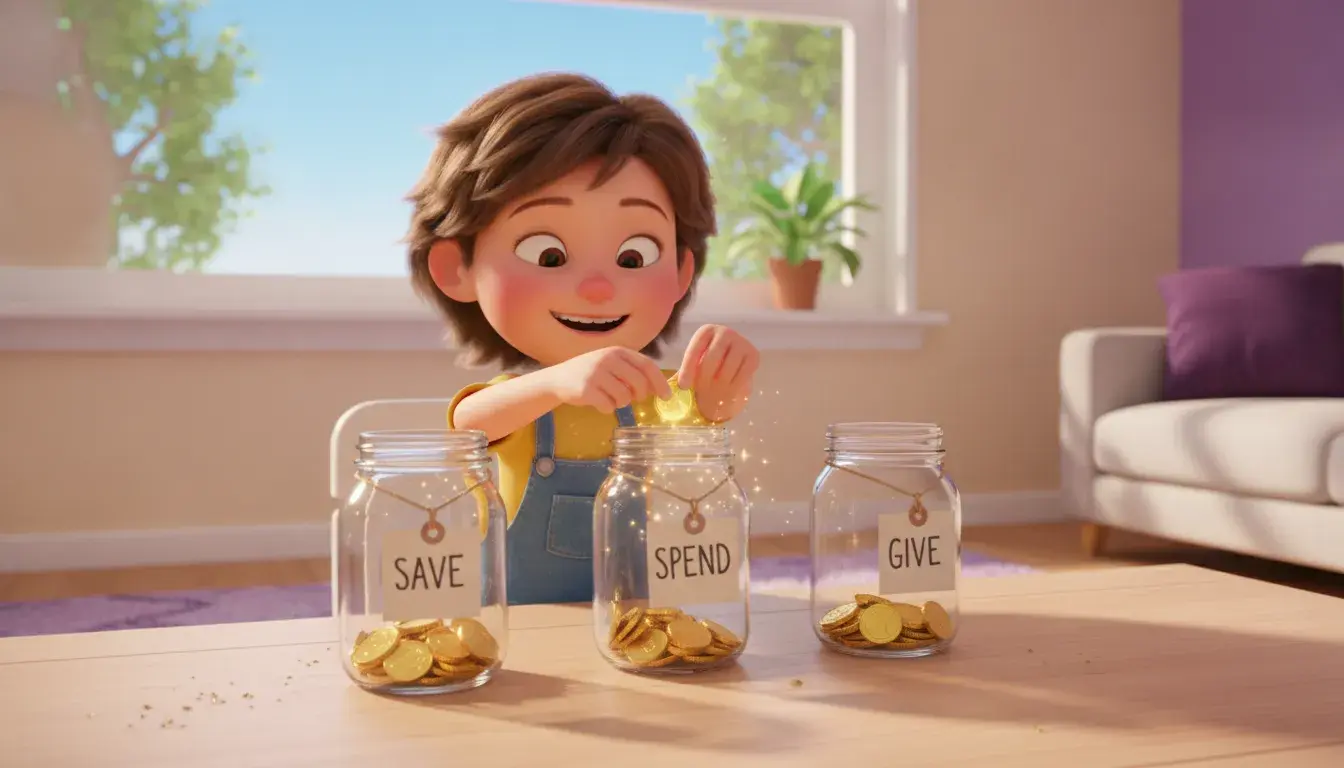
- Save, Spend, Give. The AAP suggests a similar three-way split: saving toward a goal, spending, and sharing, meaning money set aside to spend on others. Three jars make it visible.
- Compare prices together. "This cereal is $3 and that one is $5. If we pick the $3 one, we have $2 left for berries."
- Let small mistakes happen. If a $4 toy breaks in a day, don't replace it. That small sting can teach more than a lecture.
What Should 9 to 12 Year Olds Learn About Money?
The CFPB's guidance for school-age kids centers on making choices, comparing prices and putting money aside for things they want. Good practice at this age:
- Hand over a small budget. Give them the money for a friend's birthday gift and let them manage it. If they pick the expensive card, they learn what's left for the gift.
- Name the trade-off. "If you buy this game today, the skateboard is two more months away."
- Try a family match. Add a little to whatever stays in savings for a month, like 10 cents per dollar. They get to watch their savings grow.
- Needs versus wants. Go through a wish list together and sort each item.
- Think out loud. The CFPB suggests parents talk through their own everyday money choices so kids hear the reasoning.
For how money sense fits alongside the other things kids grow into, see how kids build money sense.
Frequently Asked Questions
What age should you start teaching kids about money?
Around 3. Preschoolers aren't ready for money math, but they can pay with a coin, hear what things cost, and practice short waits. The CFPB's early lessons (earning, saving, planning and choosing) are written for ages 3 to 5.
How much allowance should a 6 year old get?
Scholastic's guide is 50 cents to $1 per week for each year of age, so $3 to $6 for a 6-year-old. What it's meant to cover, and paying it on the same day every week, matter more than the exact amount.
Should I take away allowance as a punishment?
It's better not to. Keep money and discipline separate, so your child learns that what they earn and save is theirs to manage.
What if my child spends all their allowance right away?
Let it happen, and don't top it up. Being out of money until next payday is the lesson. Before the next payday, help them pick one thing to save for, and start with a goal just a week or two away.
How do I teach a preschooler about money if we never use cash?
Get a little cash for teaching. A few coins for a shop trip or a play store at home lets your child see money leave their hand. When you do tap a card, say what's happening: "That's our money going to the store."
Last updated: September 24, 2026
This article is for informational purposes only and does not constitute professional medical, psychological, educational, or financial advice.