The home program that doesn't die by Wednesday.
You get a child 30–60 minutes a week; the family has the other 167 hours. KudoKids turns the routine you prescribe — and the sounds you target — into something the child runs every day: they earn Kudo Coins for finishing it, positive reinforcement by default, free for every family, and the clinical-partner ethics paperwork is done before your first recommendation.
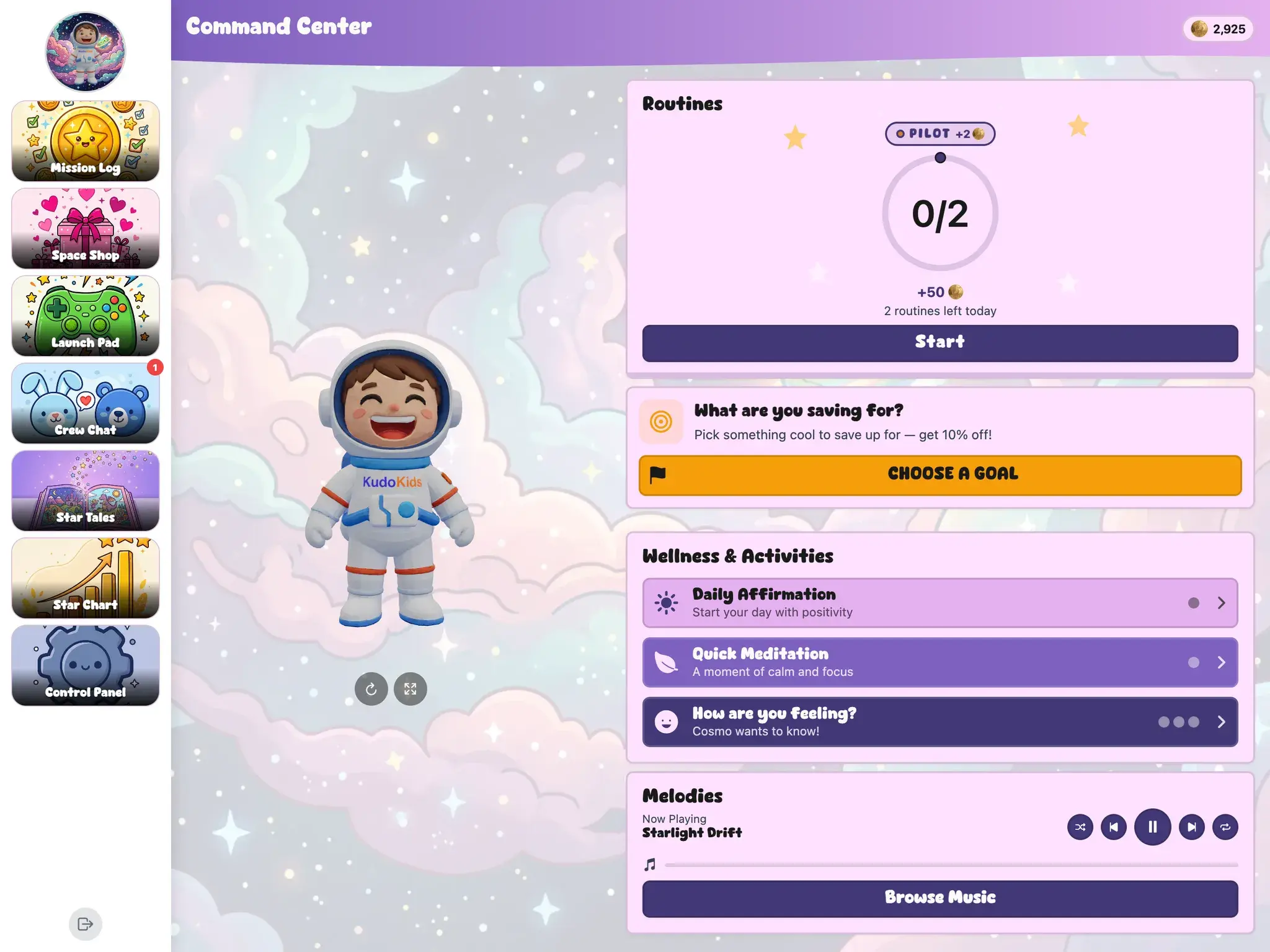
- Routines and target sounds, run daily
- Positive reinforcement by default
- Free for every family
Clinical adjunct, not a clinical intervention or a substitute for professional care. Speech-sound and reading practice is playful practice, not speech therapy. You remain responsible for your licensing board and employer rules on endorsements; the partner Letter of Understanding is a no-compensation arrangement and commits you to avoiding any conflict of interest governed by your applicable professional ethics code.
Tasks, Coins, Games — That's the Loop
Parents set routines and tasks
Chores, reading goals, wellness habits — configured once.
Kids earn Kudo Coins
Completed tasks earn coins. Educational games earn them back.
Screen time self-regulates
Fun games cost coins. No timers, no fights — kids budget themselves.
Tap any screen to see it full size.
Free plan available for families — tasks, games, wellness tools, and the parent dashboard cost nothing.
Before the feature list: three things that change for the child first, and what each one changes for you.
They arrive with something to show
The sound that was clean in your room on Thursday and not said again until the next Thursday. The grip, the sequence, the transition — same story. A kid who ran the practice every day for six days doesn't walk in the way a kid who ran it once does: they arrive already holding something, already mid-sentence about it. The daily repetition you designed is the part that was never getting to happen.
Why this works
The session opens with the child showing you their week instead of you gently finding out it didn't happen — which changes what the child thinks the room is for.
You can hand any family the whole thing free: routines and real responsibilities the child earns Kudo Coins for finishing — a target sound can be one of the steps — plus speech-sound and learn-to-read practice a parent switches on, a growing library of learning games, branching stories where the child's choices change what happens, and a parent side with one-tap approval.
A systematic review of parent-implemented home therapy programmes for speech and language found they outperformed no intervention only where dosage was high, parents received direct training, and the therapist stayed in frequent contact. Tosh, Arnott & Scarinci, 2017, International Journal of Language & Communication Disorders, 52(3), 253–269.View source →The screen starts working for the child
For a lot of these kids the tablet is the single strongest thing in the house, and it is currently pulling against everything you send home. Turning it into what the child earns by doing the routine puts the biggest lever in the room on the child's side instead of against them.
Why this works
You finally have a real answer to the question every family asks you — what do I do about screen time? — which keeps you the practical voice in that household rather than one more person issuing a caution.
Free to any family: the parent decides what Kudo Coins buy, including off-app device time the parent configures with a countdown, plus a safe browser with no address bar and no search where only parent-approved sites load.
The American Academy of Pediatrics' policy statement for ages 5–18 states that evidence on healthy media use does not support a one-size-fits-all approach, and its guidance is that families build an individualized media use plan with parent-set boundaries and consistent rules rather than a universal time cap. American Academy of Pediatrics, Council on Communications and Media, 2016, Pediatrics, 138(5), e20162592.View source →Free for every kid, nothing to disclose
The kids who would benefit most are disproportionately in the households where one more paid subscription is the reason it doesn't happen. This one is free for all of them, including the family you already know can't add anything.
Why this works
You can say it out loud in session, put it in a handout, or give it to the whole caseload without weighing whether you're steering a family toward something that pays you — because nothing about it does.
The entire stack is free to every family: routines and coins, the games and stories, the daily check-in that is never scored or graded, the safe browser, and friends that stay off until a parent turns them on.
Both governing codes treat financial interest in a recommended product as a disclosable conflict — the AOTA 2020 Code of Ethics directs practitioners not to engage in conflicts of interest or commitment (Standard 1L), or to use their position in a manner giving rise to real or perceived conflict of interest (Standard 1M). American Occupational Therapy Association, 2020, AJOT, 74(Suppl. 3), 7413410005.View source →
These citations are the research behind how KudoKids is designed. The researchers and institutions named have not endorsed or evaluated KudoKids, and we make no claim about results for children who use it.
Apply as a pediatric therapist
Start recommending KudoKids to the families on your caseload — one 2-minute application, reviewed in 3–5 business days, and your Letter of Understanding is signed digitally with the FTC disclosure language written for you.
Want the detail?
Everything a careful reader wants to check, without cluttering the page for one who doesn't.
Everything that's in the app
KudoKids turns the routine you already prescribe into something the child does every day at home: kids earn Kudo Coins by finishing the routine the parent sets, and the parent decides what the coins buy — including off-app screen time they configure. Speech-sound and learn-to-read practice is built in, and a parent switches it on. Every feature that keeps the plan alive is free for families, so cost never blocks the recommendation.
You prescribe the routine. The child runs it every day.
You set the focus in session, the parent builds it into the daily routine, kids earn Kudo Coins for finishing it, and the parent decides what the coins buy — so the plan runs every day instead of living on the fridge. Positive reinforcement by default: no failure states and no automatic coin deductions, consistent with how you're trained to build behavior.
Their target sound, in the daily routine.
Speech Sounds is a practice area a parent switches on for the family — it ships off and hidden. The parent stars the sounds you're targeting so they come up first, and can put a specific sound into the child's daily routine, so the reps earn coins the same way brushing teeth does. The child hears the sound, says it, and taps “I said it!”; the cards climb from the sound on its own to words, phrases, sentences, a story, and tongue twisters. Nothing scores how the sound came out — it gets the reps to happen, and you stay the one shaping the sound. After some sound practice, Learn to Read appears: little books and tap-along reading games with a teacher voice, no microphone in the reader, and progress the parent sees and the child never does.
The parent debrief, with data.
The parent dashboard shows what kids are earning, playing, and learning, so the parent walks into your next session knowing how the week actually went. You never access the family's data; the parent decides what to tell you, so there's no clinic account, DPA, or student data for an agency to review.
Built to survive a screen-skeptical clinician's scrutiny.
It's still an app with a growing library of games — we say so plainly. But the coins are earned by real-world routines, and parents can make off-app device time the thing coins buy. KudoKids doesn't claim to be a clinical intervention and makes no outcome claims; it's home-carryover infrastructure. You own the goals — the platform is the adjunct that keeps the plan alive between sessions.
*ads can be shown via the YouTube and web browser features if a parent turns them on.
What partners receive, and how to start
Clients Start the Plan the Same Day
Families sign up directly at kudokids.org and every feature that keeps the plan alive is free, so a client can start building the routine the day they leave your session — nothing to purchase, nothing to hand out, nothing standing between the recommendation and the routine.
Recommend Within Your Ethics Code
Clinical partners have no financial relationship with KudoKids of any kind — no commission, no discount, no free product — and the Letter of Understanding is written around professional conflict-of-interest rules, so the ethics paperwork is settled before you make your first recommendation.
The Parent Debrief Stops Being a Shrug
Parents can see the week in their dashboard — routines done, coins earned and spent — and walk into your session able to say how it actually went, turning home carryover into something you can adjust together, without ever accessing the family's data yourself.
Shape the Platform
It's live now on web, iOS, and Android — your clinical perspective goes directly into how the app develops for the families on your caseload.
Clinical Questions Answered
Questions about a specific family's situation or how KudoKids fits a behavior plan? Reach the KudoKids team directly at support@kudokids.org.
Apply
2-minute form.
Get Your Materials
Receive your Letter of Understanding and the materials to share.
Start Recommending
Introduce KudoKids to the families you work with.
Common Questions
A Letter of Understanding (a no-compensation arrangement) and a direct line to the KudoKids team for clinical questions. That's the whole list — the clinical track is deliberately non-commercial, so there are no license packs, no directory placement, and nothing of value flowing to you for a recommendation. Families sign up directly at kudokids.org.
No. Clinical partners have no financial relationship with KudoKids of any kind: no commission, no revenue share, no license packs, no directory placement, nothing paid or discounted to you for a recommendation. The commission track exists only for commercial partners, and clinicians aren't on it. This structure exists so a recommendation never creates a financial conflict of interest under the ethics codes OTs, SLPs, and behavior analysts work under.
There is no payment, discount, or other compensation to disclose — nothing of value comes back to you for recommending KudoKids. If you sign the Letter of Understanding, you do hold a named non-commercial relationship with us, and both AOTA and ASHA guidance treat non-financial relationships as worth naming, so we give you plain disclosure language in the partner portal for handouts and promotional content. Your licensing board and employer rules still govern.
No, on purpose. The child taps “I said it!” and the rep counts; nothing grades how it came out, and a try is never blocked or charged. It gets the practice to happen between sessions — the shaping stays with you. Speech Sounds is playful practice, not speech therapy.
You tell the parent; the parent stars them in the Speech & Reading settings so they come up first, and can add a specific sound to the child's daily routine. Starring never locks the rest away — the whole set stays open. You never touch the family's account.
Only if the parent turns on a second, separate switch. Optional and off by default: the device can listen and celebrate when it hears the word. Recognition happens on the device — nothing is recorded, saved, or sent anywhere. If a device can't do that work on its own, the option isn't offered. It never says a sound was wrong and never changes the coins. Reading has no microphone at all — it's tap-scored with a teacher voice.
No. It ships off and hidden — no dimmed tile, nothing on the child's Play tab — until the parent switches Speech & Reading on for the family in their settings. If you're recommending it for the sounds, tell the parent to flip that one switch; the practice tile appears for the child from there.
It's still an app with a growing library of games — we say so plainly. But the coins are earned by real-world routines, and parents can make off-app device time the thing coins buy. Everything else is instant. KudoKids makes it earned.
KudoKids doesn't claim to be a clinical intervention and makes no outcome claims — it's home-carryover infrastructure. You own the goals; the platform is the adjunct that keeps the plan alive between sessions. Recommend it as a clinical adjunct, not as treatment.
No. KudoKids is free for every family — routines and tasks, the full library of games, speech-sound and learn-to-read practice, the parent dashboard, and the first companion, Cosmo. Premium ($11.99/mo or $99.99/yr) is optional and only unlocks the other themed worlds, companions, backgrounds, and companion looks and extras, plus KudoKids AI, a parent-side setup assistant kids can never talk to.
Ready to partner with KudoKids?
Apply in 2 minutes. Sign your Letter of Understanding and start recommending KudoKids to the families you serve.