A child can arrive tonight. The routine can be ready by bedtime.
Placements happen with no notice, and the family builds structure from zero. KudoKids is live now on web, iOS, and Android, so a caregiver can set up a visible morning and bedtime routine in minutes — free for every family, with no financial relationship for your org and nothing to disclose.
- Ready the night a child arrives
- Free for every family
- No financial relationship · nothing to disclose
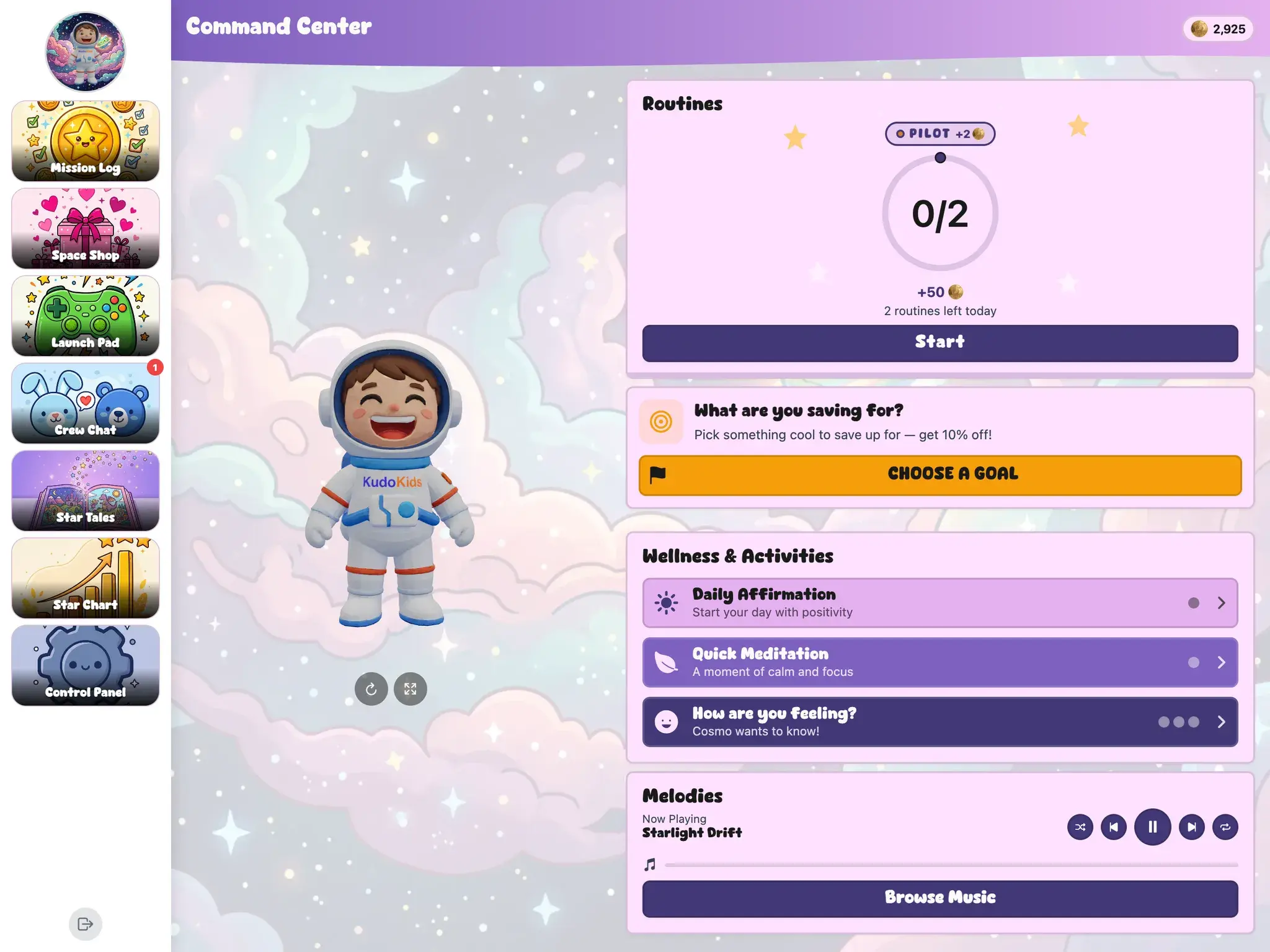
Tasks, Coins, Games — That's the Loop
Parents set routines and tasks
Chores, reading goals, wellness habits — configured once.
Kids earn Kudo Coins
Completed tasks earn coins. Educational games earn them back.
Screen time self-regulates
Fun games cost coins. No timers, no fights — kids budget themselves.
Tap any screen to see it full size.
Free plan available for families — tasks, games, wellness tools, and the parent dashboard cost nothing.
Before the feature list: three things that start with the child, and what each one changes for the caregiver you hand this to.
Something that isn't a correction
A child who has learned that when an adult walks toward them, it's usually about something they did. In the first week of a placement almost every interaction is an instruction, an assessment, or a rule from someone they met yesterday. Very little of it is just nice.
Why this works
The caregiver and the child get one thing on the table between them that isn't a correction — a story the companion reads aloud where the child's choices change the ending, a singalong, a game the two of them play on one couch. The adult's job for that half hour is not to enforce anything. The caregiver is still the person who matters here; this is only something to do together while that takes the time it takes.
All of it free, and the shared half hour is not the paid part and never becomes the paid part — Premium adds only the other themed worlds, companions, backgrounds, and companion looks and extras, plus KudoKids AI, a parent-side setup assistant kids can never talk to. A caregiver who wants to can use the stories and the games and never set a single task. What your org hands over is something to do with a child on night one, when nobody knows what to do with each other yet.
The American Academy of Pediatrics states that "mental and behavioral health requires the presence of at least 1 nurturing, responsive caregiver who is stable in the child's or teen's life over time," and that children and teens thrive where routines and structure come together with warmth and nurturance. That caregiver is a person, not a product, and nothing here substitutes for one. American Academy of Pediatrics, Mental and Behavioral Health Needs of Children in Foster Care, drawn from Pediatrics, 2015, 136(4), e1131–e1140.View source →A child who chose none of this
A child in care picked none of it. Not the house, not the bedroom, not the school, not who drives them to it. Choice is precisely the thing that was taken, and a seven-year-old feels that long before they can say it.
Why this works
The caregiver gets to be the adult who says yes. They set the boundary once — which categories are available, what coins can buy — and inside that boundary the child decides: which story, which ending, what to save for. The negotiation moves off the adult and onto a menu the adult already approved, so a caregiver who has had to say no to a great deal this week has something they can say yes to.
Free, all of it: a daily check-in that is never scored and never graded, with breathing, a meditation, or just time with the companion afterward if the child wants it. Branching stories where the choices change the ending. Coins the child decides how to spend, on a menu the caregiver set. Affirmations and meditations only in the categories the caregiver approved.
A systematic review of 170 studies, screened from 4,297 published between 1950 and 2020, found daily routines are associated with positive developmental outcomes across cognitive, self-regulation, social-emotional, academic, and health domains, with particular attention to their protective role for children in high-risk environments. Selman & Dilworth-Bart, 2024, Journal of Family Theory & Review, 16(2), 272–328.View source →The child on their fifth bedroom
A child who has already packed and unpacked four times. Every house came with a new set of rules, a new chart on a new fridge, and a new adult explaining how things work here — and each time, the child learned a little more that none of it lasts.
Why this works
What the child is watching for is whether day sixty looks like day one. The caregiver sets the expectations, the child can see them, and they don't quietly change when the week gets hard. Nothing is posted, nothing is public, and no chart exists for anyone outside the household to read — this is between the two of them, not a record of the child.
The hard part first: point-and-reward systems are genuinely contested in trauma-informed and attachment-focused caregiving, and connection comes before correction. A child in care is not a behavior to be managed, no earned coin stands in for an adult being present, and we make no claim this fits every child — your trainer decides that. What we can offer is something a trainer can examine and clear: every expectation and every reward set by the caregiver, nothing leaving the household, no agency account and no outside login, layering under the framework you already teach rather than competing with it. Free, so a caregiver is never choosing between the structure and the grocery budget.
In a randomized trial, foster parents who received the KEEP support-and-training program — which centers consistent structure and positive reinforcement in the caregiver's hands — had children with nearly double the rate of positive placement exits. KEEP is a manualized program delivered by trained facilitators to caregivers: KudoKids is not KEEP, is not a training program, has no comparable evidence, and makes no claim about placement stability. The trial is why every setting stays with the caregiver — it is not a result we claim. Price, Chamberlain, Landsverk, Reid, Leve & Laurent, 2008, Child Maltreatment, 13(1), 64–75.View source →
These citations are the research behind how KudoKids is designed. The researchers and institutions named have not endorsed or evaluated KudoKids, and we make no claim about results for children who use it.
Apply as a foster & kinship organization
Apply in two minutes to get a one-page safety facts sheet and a ready-to-forward handout — you'll sign a short Letter of Understanding, with no financial relationship and nothing to disclose.
Want the detail?
Everything a careful reader wants to check, without cluttering the page for one who doesn't.
Everything that's in the app
A child arrives overnight, often with belongings in a trash bag, and a tired family starts building structure with no budget and no answers for days — the gap where too many families stop in year one. KudoKids gives them a predictable routine they can stand up that same night, free forever, and your org never has to buy, host, or disclose a thing.
Ready the night a child arrives — set up in minutes on the device the family already has
Every first-week guide says the same thing: keep it simple and build a predictable routine right away. KudoKids is live now on web, iOS, and Android, so a caregiver can stand up a visible morning and bedtime routine in minutes — no new device to buy, no tech afternoon. It's designed for the shape of a first week: a daily check-in that is never scored and never graded, and a comfort flow the child can choose afterward. The same holds for a grandparent raising a grandchild or an adoptive family settling in.
The free plan is the whole product, so it goes on a resource list — not a budget line
Free Explorer includes the routines and tasks, the full library of games, the wellness tools (mood check-ins, meditations, sleep sounds), the parent dashboard, and the first companion, Cosmo, the astronaut kid. A family with no budget gets the real thing, forever. Premium ($11.99/mo or $99.99/yr) only unlocks the other themed worlds, companions, backgrounds, and companion looks and extras, plus KudoKids AI, the parent-side setup assistant — Premium never puts a wall in front of the learning, and it never pressures a child. Families sign up directly: no license, no procurement, no case data, no committee.
Earned, private, and in the caregiver's hands — never posted, never public
Kids earn Kudo Coins by finishing the routines and tasks the caregiver sets, and the caregiver decides what coins buy, including off-app screen time they configure. Nothing is posted publicly and no chart is displayed to anyone outside the family. KudoKids doesn't claim to treat trauma and isn't a behavior-modification program — it's a structure tool that layers under whatever framework your trainers teach, and your trainer decides how and whether it fits a given family. The screen moves inside the routine instead of against it.
*ads can be shown via the YouTube and web browser features if a parent turns them on.
What partners receive, and how to start
A One-Page Safety Facts Sheet
Plain-language answers for your vetting file and your trainings — ready to hand a caregiver or drop into a packet.
Nothing to Disclose
Community partners have no financial relationship with KudoKids — no commission, no referral fee. Recommending it never breaks a no-soliciting rule.
A Ready-Made Handout & Pass-Along Paragraph
A printable, brand-clean handout plus three sentences you can paste straight into a newsletter, training packet, or closed group.
A Partner Listing
Your organization listed as a KudoKids community partner, so families see a recommendation that's been vetted — not an ad.
Reach the Founding Team
Vetting questions from a coordinator get a real human at support@kudokids.org, not a support queue.
Apply
2-minute form.
Get Your Materials
Receive your Letter of Understanding and the materials to share.
Start Recommending
Introduce KudoKids to the families you work with.
Common Questions
KudoKids doesn't claim to treat trauma and isn't a behavior-modification program. It's a structure tool that stays entirely in the caregiver's hands — visible routines, earned Kudo Coins, and rewards the family defines, all private to the household. It layers under whatever framework your trainers teach, and your trainer decides how and whether it fits a given family.
Agreed, and there's nothing to sell. Community partners have no financial relationship with KudoKids — no commission, no referral fee — and nobody markets to families inside your groups. The free plan is the full product minus the other themed worlds, companions, backgrounds, and companion looks and extras — and, for parents, KudoKids AI, the parent-side setup assistant. Premium exists ($11.99/mo, $99.99/yr), but a family that never pays a cent keeps everything that matters, and KudoKids never shows ads in the app.
It's built to shrink screen fights, not grow them. KudoKids never shows ads in the app, no child data is sold, friends stay off until the caregiver turns them on, and the caregiver chooses how new friends are approved — and kids earn toward off-app device time the caregiver configures, so the screen moves inside the routine instead of against it. It's a tool for ages 3–12 that stays in the caregiver's hands.
Fair question. KudoKids is live now on web, iOS, and Android, founder-funded with no venture capital, and recommended by child-development experts. No inflated numbers. The ask is that one coordinator try it free, no card, the way a caregiver would, before it goes on any list. support@kudokids.org answers directly.
Yes. It's free, there's no new device to buy, and setup takes minutes on whatever phone or tablet is already in the house. A grandparent raising a grandchild gets the same visible routine, mood check-ins, and sleep sounds — plus a parent dashboard that shows what the child is earning, playing, and learning.
No. No procurement, no contracts, no case data, nothing to host. Families create their own accounts directly at kudokids.org and the core app is free to use. For your org it's one line on a resource list or one handout — the way a foster closet sits on that list.
Ready to partner with KudoKids?
Apply in 2 minutes. Sign your Letter of Understanding and start recommending KudoKids to the families you serve.