Every talk ends the same: so what CAN they do?
You teach families to set limits — then a hand goes up asking for a name. KudoKids is the constructive answer: safe screen time for kids 3–12 that instills growth, layered onto the limits you already teach, and free for every family.
- 20–25% recurring commission for 12 months
- Recommend the free plan — no family has to pay for your advice to work
- Disclosure sentence provided — FTC disclosure required on promotional content
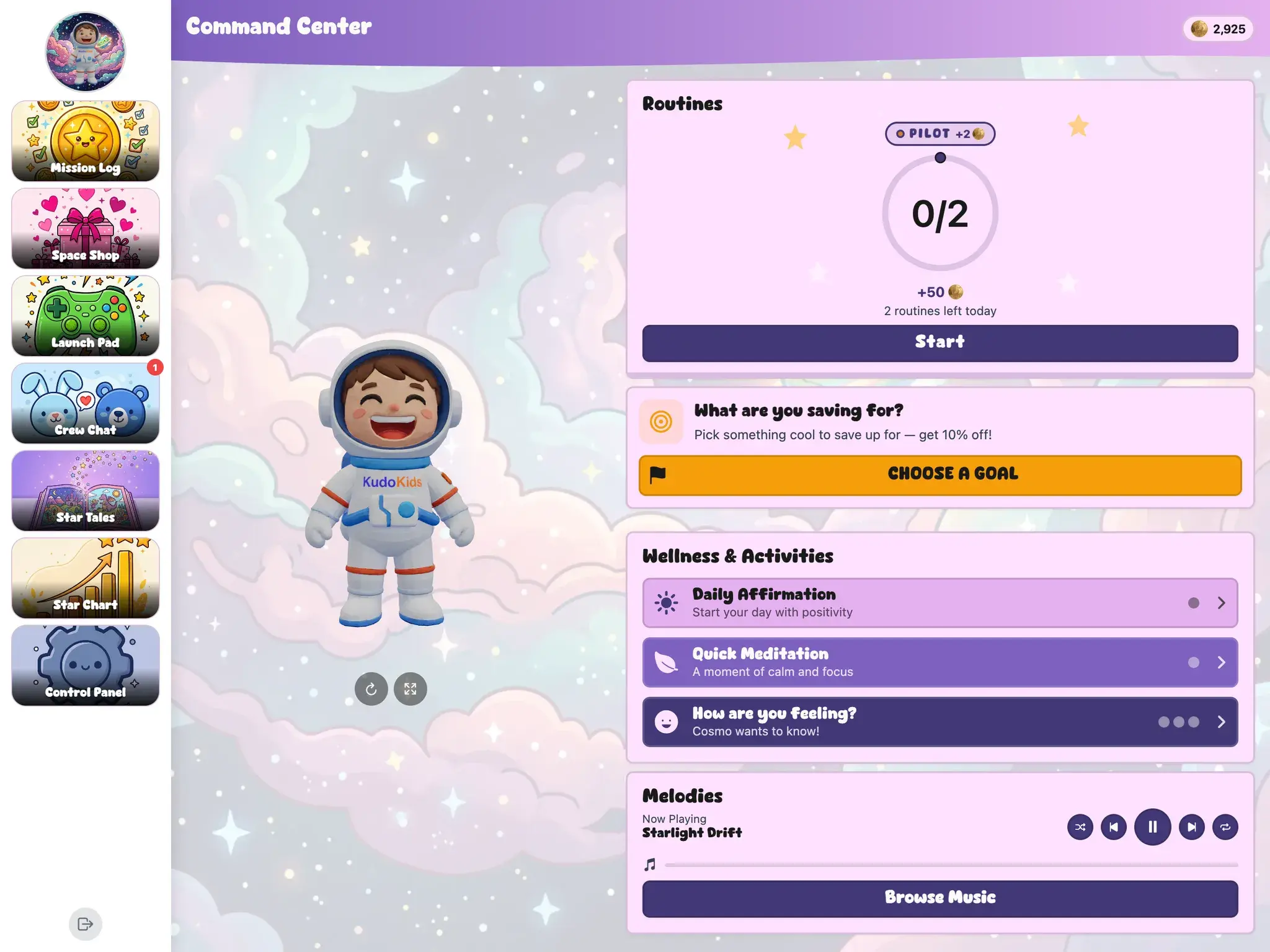
Tasks, Coins, Games — That's the Loop
Parents set routines and tasks
Chores, reading goals, wellness habits — configured once.
Kids earn Kudo Coins
Completed tasks earn coins. Educational games earn them back.
Screen time self-regulates
Fun games cost coins. No timers, no fights — kids budget themselves.
Tap any screen to see it full size.
Free plan available for families — tasks, games, wellness tools, and the parent dashboard cost nothing.
Three children you have already met in your own Q&A — and what you get to hand their parents.
The hole where the tablet was
A seven-year-old whose parents did exactly what your workshop said. The tablet went in the drawer on Sunday. It is Tuesday at 5:40, he is standing in the kitchen doorway with nothing to do and no idea what he is allowed to want, and everyone in the house can feel that the plan has a hole in the middle of it. The limit was right. The child is still stranded in it.
Why this works
Right now he experiences his parent as the person who takes things away and then can't say what comes next. Put something on the other side of the rule — something he can work toward and actually reach — and the parent stops being the enforcement mechanism and goes back to being the person who set him up to win.
The missing half of your own closing slide: a structure the parent configures — which routines count, what each one earns, what the coins may be spent on, what needs a sign-off — instead of a minute count the family blows past by Wednesday. Free Explorer is the entire system, so it works for every family in the room, including the ones who came because money is tight. If a family later chooses Premium, that referral pays 20–25% recurring for 12 months, with the disclosure sentence supplied.
The American Academy of Pediatrics does not set a single time limit for all children, recommending instead “considering the quality of interactions with digital media and not just the quantity, or amount of time,” and noting that rules “focusing on balance, content, co-viewing and communication are associated with better well-being outcomes than rules focused on screen time.” AAP Center of Excellence on Social Media and Youth Mental Health, Screen Time Guidelines, Q&A Portal.View source →The child who stopped telling you things
The eleven-year-old who saw something that scared her and decided, in about a second and a half, not to mention it — because the last time something came up, the device disappeared for a week. The prohibition worked exactly as designed. It also taught her that the adult is the last person to tell.
Why this works
This is the corrosion the screen fight actually causes: not the arguing, the silence after it. When the terms were visible and agreed before the week started, there is nothing to conceal, and a bad moment online becomes something she brings to a parent instead of something she manages alone.
For the parent who tells you confiscation is the only move they have left: in KudoKids the terms are visible to the child up front — what counts, what it earns, what it buys — so the arrangement is one the family agreed to rather than one enforced by removal. The concession, before you have to make it for us: a coin economy is an external reward system, and this literature files those under controlling mediation. We are not claiming rewards beat limits. The narrower thing we would defend is that the child sees and agrees to the terms in advance. Free either way; if a family later upgrades, that referral pays 20–25% recurring for 12 months, disclosed.
In a US survey of adolescents, punitive and controlling parental mediation was associated with more risky online experiences, operating through children's expectation that telling a parent would go badly, while autonomy-supportive parenting was associated with fewer. The sample is adolescents rather than the 3–12 range, and the design is cross-sectional and correlational. Young & Tully, 2022, Cyberpsychology: Journal of Psychosocial Research on Cyberspace, 16(2), Article 5.View source →The six-year-old who can make his own lunch
A six-year-old who has never been asked to do anything the household actually depends on. The screen argument is the visible problem; the invisible one is that nothing else in his day has any weight to it.
Why this works
A child who contributes is a child a parent gets to be proud of out loud, on a Tuesday, for something ordinary. That is a different relationship than one conducted entirely through negotiating minutes.
The earned-time chart you hand out, running as a system instead of a printable that dies by Friday — the earning event is the real routine, in the real house, approved by the real parent, and the parent prices every reward in the store. Free Explorer covers all of it. If a family later upgrades, that referral pays 20–25% recurring for 12 months, disclosed.
In 207 parents of children aged 5–13, children's engagement in self-care chores such as making themselves a meal, and in family-care chores, predicted stronger working memory and inhibition, controlling for age, gender and disability status. The design is cross-sectional and the measures are parent-report, so it describes why early responsibility matters rather than showing that chores produce it. Tepper, Howell & Bennett, 2022, Australian Occupational Therapy Journal, 69(5), 585–598.View source →
These citations are the research behind how KudoKids is designed. The researchers and institutions named have not endorsed or evaluated KudoKids, and we make no claim about results for children who use it.
Apply as a screen-time coach
Quick application — connect Stripe, choose your commission tier, and approved coaches get their partner link and pass-along assets right away.
Want the detail?
Everything a careful reader wants to check, without cluttering the page for one who doesn't.
Everything that's in the app
The answer to the question every workshop ends on — a real name you can say from the stage. KudoKids operationalizes the earned-screen-time framework you already teach: earned by routines, decided by parents, bounded on purpose. The parent decides what the coins buy — including rewards that aren't screens at all, like a trip to the park or choosing dinner, and off-app device time the parent configures — and it's free for the families you coach.
Your framework, shipped: earned by routines, decided by parents
You already teach earned, bounded, intentional screen time. KudoKids runs it as a product instead of a paper chart. Parents set the tasks and routines that matter this week; kids earn Kudo Coins by finishing them; and parents decide what the coins buy — including off-app device time the parent configures. It puts the thing you teach into practice rather than arguing with it.
It layers onto the limits you teach — and replaces none of them
KudoKids doesn't ask families to abandon the boundaries you gave them; it gives the 'yes' side of the plan structure. The parent stays the decision-maker at every step, and the parent dashboard shows what kids are earning, playing, and learning.
Free for the families you coach — demo it live from the stage
The free Explorer plan is the whole system: routines and tasks, the full library of games, the parent dashboard, and the first companion, Cosmo the astronaut kid. You can recommend it from the stage without asking a single family to spend money, and because it's live now on web, iOS, and Android, you can demo it right in the room. Premium ($11.99/mo or $99.99/yr) only unlocks the other themed worlds, companions, backgrounds, and companion looks and extras, plus KudoKids AI, a parent-side setup assistant kids can never talk to — Premium never puts a wall in front of the learning.
What partners receive, and how to start
Recurring Commission That Fits How You Earn
20–25% recurring commission on every Premium upgrade you refer, for 12 months from their first payment, paid through Stripe Connect. It is the same disclosed-affiliate model this field already runs, applied to a product that agrees with your curriculum.
A Free Answer for Your Workshop
The free Explorer plan is a real gift to the room — the whole system, with nothing your audience has to buy. Recommend it from the stage and your advice works for every family, not just the ones who spend.
Disclosure Built In, Credibility Intact
We provide the FTC disclosure sentence, and the recommendation stands on the free plan — so no family ever has to pay for your advice to work. It's the same disclosed-partner model the field's most trusted names already use.
The Trust Facts, Stated Plainly
KudoKids never shows ads in the app. Friends stay off until a parent turns them on, and the parent chooses how new friends are approved. No child data sold. The answer to the family-tech scar you carry.
Three Sentences You Can Paste
Ready-made pass-along language for your newsletter, your closing slide, or the hallway conversation after the talk — the advice that finally survives the drive home.
Reach the Founding Team
When you need help with a demo, your content, or a compliance question, you reach the founding team directly — not a support queue.
Apply
2-minute form.
Share
Get your link, assets, and start promoting.
Make an Impact
Share Premium passes, direct a marketing impact fee to a cause, or opt into commission.
Ways to partner — impact, sponsorship, or commission
Most partners join to make an impact, not income — a free Premium account and Premium passes to share, with no financial relationship and nothing to disclose. You can also direct a KudoKids marketing impact fee to a 501(c)(3) you choose, or opt into commission.
Impact Partner — the default
Share KudoKids because you believe in it. No financial relationship, no disclosures — a free Premium account and Premium passes to give families.
Direct a marketing impact fee to a 501(c)(3)
When families you refer upgrade to Premium, KudoKids pays an impact fee from its marketing budget directly to a 501(c)(3) of your choice. You don't receive income — it's a business fee we direct toward causes our partners care about.
Prefer to earn commission?
Earn 20–25% recurring for every family that upgrades to Premium — via Stripe Connect, NET 30, scaling from 20% to 25% with volume. Taxable income (1099); FTC disclosure required. Select the affiliate option when you apply.
Common Questions
It is an app with a growing library of games and a paid upgrade — we say so plainly, and we pay a commission. But Kudo Coins are earned off-screen through the tasks and routines parents set, parents approve completions and decide what the coins buy, and earned time can be off-app device time the parent configures. It puts 'earned, bounded, intentional' — the thing you teach — into practice rather than arguing with it. What we claim is about the design, not about hours in real families: the parent stocks the reward store and prices it, so what a child earns toward can be a trip to the park or choosing dinner rather than a screen at all.
Disclosure is required, not discouraged — we provide the disclosure sentence, and the recommendation stands on the free plan, so no family ever has to pay for your advice to work. It's the same disclosed-partner model the field's most trusted names already run. And KudoKids is founder-funded with no VC, so there's no pressure to monetize families sideways.
The practices are verifiable and stated without badges — KudoKids never shows ads in the app, friends stay off until a parent turns them on, and the parent chooses how new friends are approved, and no child data is sold. We'd rather you test it with your own kids first: the product is live now, and the free plan is the full system, so you can vet it end to end before you ever say its name from the stage.
The rewards attach to real-world responsibilities the parent chooses, the parent approves completions, and the parent sets what the coins purchase. Wellness tools — mood check-ins, meditations, and sleep sounds — are built in. It automates the family reward chart you already hand out; the difference is it doesn't fall off the fridge.
20–25% recurring commission per referred Premium subscriber, for 12 months from their first payment. Commission is paid via Stripe Connect, NET 30, minimum payout $25. It's standard taxable income — you'll receive a 1099 at year-end if applicable. FTC disclosure is required on all promotional content.
No. The free Explorer plan is the whole system — routines and tasks, the full library of games, the parent dashboard, and the first companion, Cosmo. Premium ($11.99/mo or $99.99/yr) is optional; it only unlocks the other themed worlds, companions, backgrounds, and companion looks and extras, plus KudoKids AI, the parent-side setup assistant, and Premium is a parental-relief spend outlet for the coins kids earn. The free plan is the one to recommend, so your advice carries zero financial risk for the families you coach.
Ready to partner with KudoKids?
Apply in 2 minutes. Get free Premium passes to share with families — and direct a marketing impact fee to a cause you care about.