The plan works in week one. It dies by week three.
Between sessions, running your plan falls entirely on a tired parent — 167 hours you can't supervise. KudoKids is the implementation layer that keeps your routines running: kids earn Kudo Coins for doing the plan you wrote, and parents decide what the coins buy. Free for every client family, with 20–25% recurring commission for 12 months on the tool you already recommend.
- 20–25% recurring commission for 12 months
- Free for every client family — the full core product at $0
- Not a parenting course — it never competes with your curriculum (FTC disclosure required)
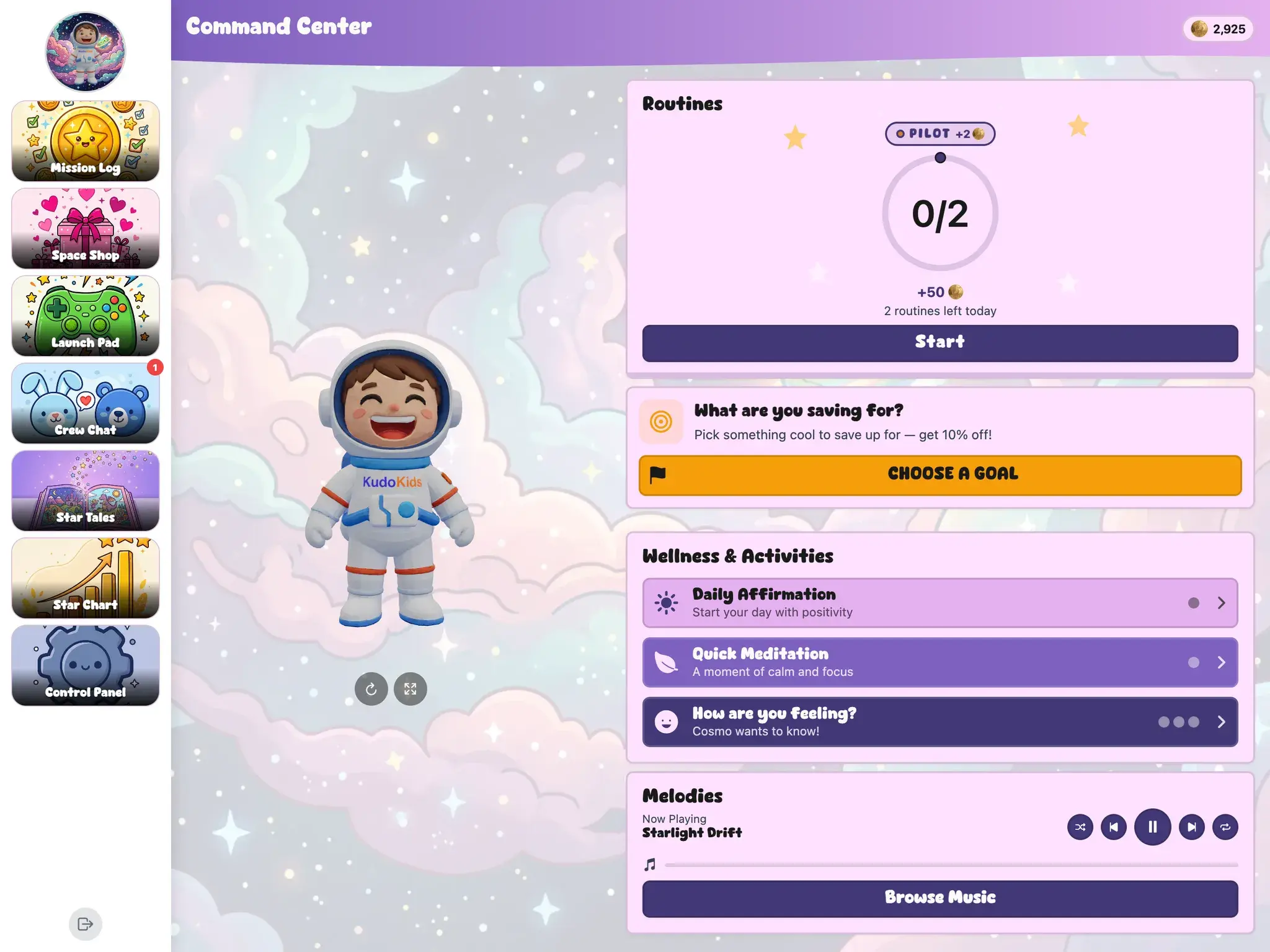
Tasks, Coins, Games — That's the Loop
Parents set routines and tasks
Chores, reading goals, wellness habits — configured once.
Kids earn Kudo Coins
Completed tasks earn coins. Educational games earn them back.
Screen time self-regulates
Fun games cost coins. No timers, no fights — kids budget themselves.
Tap any screen to see it full size.
Free plan available for families — tasks, games, wellness tools, and the parent dashboard cost nothing.
Before the commission details: three things that start with the child your client came to you about, and what each one changes for the plan you wrote.
The plan was for the child. The child is the one who doesn't get it.
When a parent abandons a plan at week three, nobody records what happened to the child. The dropout gets counted; the kid it was written for does not. A plan that starts and stops teaches that child something specific — that the new way of doing things is temporary and the old way is the real one. The next time a parent introduces a system, the child already knows how it ends.
Why this works
The abandoned attempt costs the parent credibility with their own child. The parent goes back to enforcing with less standing than they had before they started, which usually means enforcing harder. The child reads the whole sequence as: nothing here actually changes.
A place for your plan to run that doesn't depend on a tired parent restarting it every night. The routines are yours; the daily execution is the child's, in a system the child is glad to open. The free Explorer plan covers all of it, so your recommendation is fully useful at $0 and your client's follow-through never has a paywall in front of it.
Follow-through is a measured problem across the whole category, not something unique to any one practice. Across 262 studies of behavioral parent training, at least 25% of parents identified as appropriate for the program never enrolled and another 26% dropped out before completing it — leaving, in the authors' words, "at best half of identified parents completing treatment." That figure describes the field's research literature, not KudoKids. Chacko, Jensen, Lowry, Cornwell, Chimklis, Chan, Lee, & Pulgarin, 2016, Clinical Child and Family Psychology Review, 19(3), 204–215.View source →Nobody notices the middle
Most children are only noticed at the two ends — when they nail it and when they blow it. The middle, where they're trying and it's going badly and they keep going anyway, is invisible. A child who is only ever seen at the outcome learns to protect themselves by not attempting things they might not win.
Why this works
The parent's daily line to their child changes. "Did you do it yet" is a check on compliance; noticing that the bed got made badly but got made is a different sentence, and children hear the difference. Coins are earned for doing the task, not for doing it well — so what the parent's attention lands on each day is effort on a real responsibility, which is usually the exact shift you've been trying to install since session one.
An effort economy you already agree with, running daily, at $0. Coins are earned for process and never paid out for a result, and the parent — guided by you — sets what coins are worth, so the values in the system stay yours and the family's.
In a naturalistic study of parent–child interaction at home, effort-focused ("process") praise to children aged 14–38 months predicted those children's belief that ability grows through effort at ages 7–8 (N = 53). Praise for inherent ability did not predict fixed beliefs, suggesting the association ran specifically through effort-directed feedback. This is a small, correlational study about how parents speak — not about apps — and we make no claim about what KudoKids does to how a child thinks. Gunderson, Gripshover, Romero, Dweck, Goldin-Meadow, & Levine, 2013, Child Development, 84(5), 1526–1541.View source →A record, not a memory
The child has no idea they're getting better. Nobody keeps a record of an ordinary week, so the only account of it is the parent's memory — and memory weights the bad nights. A child who hears a summary of their own week built out of the worst two evenings in it will not recognize themselves in it, and will argue.
Why this works
With a record, the parent and the child are looking at the same week. The conversation moves off character — "you never" — and onto a list of what happened. That's a smaller, more survivable disagreement, and it's one the child can win sometimes, which is usually the point.
Routines completed, coins earned, and what the coins bought are recorded on the parent's dashboard, with one-tap or batch approval. Parents choose what needs their sign-off, and parents choose what, if anything, they show you. There's no coach portal and no integration — the dashboard is theirs. The family can simply arrive at the next session with a record of the week instead of a recollection of it.
Across 138 randomized trials with nearly 20,000 participants, prompting people to monitor progress toward a goal sharply increased how often they tracked it (d+ = 1.98) and improved goal attainment (d+ = 0.40), with stronger effects when progress was physically recorded or reported to someone else. This is goal-monitoring research on predominantly adult samples, not a finding about children 3–12. Harkin, Webb, Chang, Prestwich, Conner, Kellar, Benn, & Sheeran, 2016, Psychological Bulletin, 142(2), 198–229.View source →
These citations are the research behind how KudoKids is designed. The researchers and institutions named have not endorsed or evaluated KudoKids, and we make no claim about results for children who use it.
Apply as a parenting coach
Quick application. Connect Stripe and choose your commission tier — approved coaches get their partner link, pass-along copy, and assets right away.
Want the detail?
Everything a careful reader wants to check, without cluttering the page for one who doesn't.
Everything that's in the app
KudoKids is safe screen time for kids 3–12 that instills growth — the daily system that makes your coaching stick after the client leaves the call. Your framework decides what the routines are; KudoKids keeps them running the other 167 hours a week, so follow-through stops depending on parent willpower alone.
Your system, kept running — the 167 hours you can't supervise
Your framework decides what the routines are; KudoKids makes them run daily. Kids earn Kudo Coins for doing the plan you wrote, whether families work with you 1:1 or through your course. There's no coach portal to manage — the dashboard is the parent's, and clients can tell you what it shows between sessions, so your next session builds on what actually happened at home.
The motivation question, answered directly
It's an effort economy, not a bribe. Coins are earned by doing real tasks and routines — process, not outcome — and the parent, guided by you, decides what the coins are worth. It's the maintained version of the routine chart many coaches already assign. Wellness tools sit right beside the emotion-coaching work you already do, all free on the Explorer plan.
Safe enough to put your name on
The free Explorer plan is the full core product — routines and tasks, the full library of games, the wellness tools, the parent dashboard, and the first companion, Cosmo, the astronaut kid. Only the other themed worlds, companions, backgrounds, and companion looks and extras — plus, for parents, KudoKids AI, a setup assistant kids can never talk to — are Premium ($11.99/mo or $99.99/yr). It's live now on web, iOS, and Android, so a client family can start between this session and the next.
What partners receive, and how to start
Paid for the Tool You'd Recommend Anyway
20–25% recurring commission on every Premium upgrade a referred family keeps, for 12 months from their first payment — paid through Stripe Connect. Not a one-time course bounty on families who go on paying monthly.
A Zero-Risk Recommendation
The free Explorer plan is the full core product, so a client family gets everything you need for the work at $0. Commission only ever exists if they later choose Premium.
It Never Competes With Your Course
KudoKids teaches parents no methodology — it's kid-facing implementation, not curriculum. Your system decides the routines; KudoKids keeps them running, extending the visible results of your own program.
Pass-Along Copy, Ready to Send
Three client-facing sentences you can paste to a family — including the disclosure line — so you control exactly how, and whether, money ever enters the conversation.
Reach the Founding Team
Questions about a client's situation or your content? Reach the people building KudoKids directly — not a support queue.
Apply
2-minute form.
Share
Get your link, assets, and start promoting.
Make an Impact
Share Premium passes, direct a marketing impact fee to a cause, or opt into commission.
Ways to partner — impact, sponsorship, or commission
Most partners join to make an impact, not income — a free Premium account and Premium passes to share, with no financial relationship and nothing to disclose. You can also direct a KudoKids marketing impact fee to a 501(c)(3) you choose, or opt into commission.
Impact Partner — the default
Share KudoKids because you believe in it. No financial relationship, no disclosures — a free Premium account and Premium passes to give families.
Direct a marketing impact fee to a 501(c)(3)
When families you refer upgrade to Premium, KudoKids pays an impact fee from its marketing budget directly to a 501(c)(3) of your choice. You don't receive income — it's a business fee we direct toward causes our partners care about.
Prefer to earn commission?
Earn 20–25% recurring for every family that upgrades to Premium — via Stripe Connect, NET 30, scaling from 20% to 25% with volume. Taxable income (1099); FTC disclosure required. Select the affiliate option when you apply.
Common Questions
20–25% recurring on every Premium subscription a referred family keeps, for 12 months from their first payment — paid through Stripe Connect. Unlike the one-time course bounties that dominate the parenting affiliate space, this pays monthly on a subscription. Commission is standard taxable income; you'll receive a 1099 at year-end if applicable.
It's an effort economy, not a bribe. Coins are earned by doing real tasks and routines — process, not outcome — and the parent, guided by you, decides what the coins are worth. It's the maintained version of the routine chart many coaches already assign. We won't pretend it isn't an external structure; we'd argue structure is exactly what the follow-through gap needs.
No. KudoKids teaches parents no parenting methodology — it's kid-facing implementation, not curriculum. Your system decides what the routines are, and KudoKids keeps them running, which extends the visible results of your own program.
The free Explorer plan removes the sting: your recommendation is fully useful at $0, disclosure is expected on every referral, and commission only exists if a family later chooses Premium. No earnings projections, no pressure mechanics — you control how, and whether, money ever enters the conversation.
It's screen time that gates itself. The earning happens off-screen — tasks, routines, responsibilities — and parents can price off-app device time in coins, so screen time becomes earned through effort instead of contested. KudoKids never shows ads in the app, no child data is sold, and friends stay off until a parent turns them on, and the parent chooses how new friends are approved — the safety practices hold up to the scrutiny you'll apply.
Yes — required by law and your Commercial Agreement. Every piece of content that promotes KudoKids must include clear FTC disclosure (#ad, #sponsored, 'paid partnership,' or a plain spoken disclosure). This applies to social posts, emails, courses, podcasts, and any client-facing recommendation.
Ready to partner with KudoKids?
Apply in 2 minutes. Get free Premium passes to share with families — and direct a marketing impact fee to a cause you care about.