An answer for the screen-time question at the storytime desk.
Safe screen time for kids 3–12 that instills growth — it never shows ads in the app or sells child data, and it's free for every family. There's nothing for your library to buy, host, or disclose. You can vet every line yourself in five minutes.
- Vet it yourself in five minutes
- No ads*
- No child data sold
- Free for every family
*ads can be shown via the YouTube and web browser features if a parent turns them on.
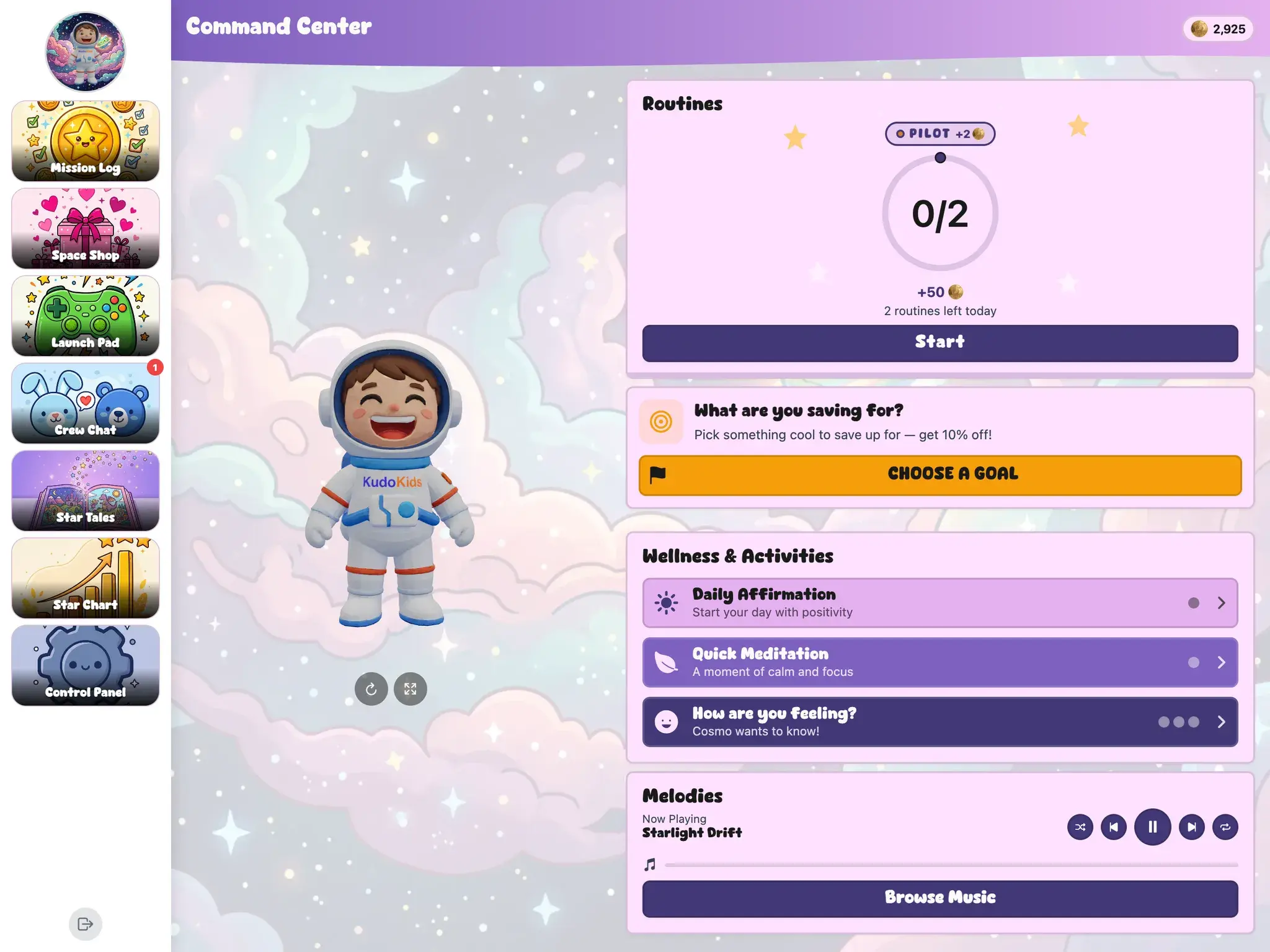
Tasks, Coins, Games — That's the Loop
Parents set routines and tasks
Chores, reading goals, wellness habits — configured once.
Kids earn Kudo Coins
Completed tasks earn coins. Educational games earn them back.
Screen time self-regulates
Fun games cost coins. No timers, no fights — kids budget themselves.
Tap any screen to see it full size.
Free plan available for families — tasks, games, wellness tools, and the parent dashboard cost nothing.
Three children you already know by sight — and what a family gets to take home for each one.
The kid on a screen four hours a day because it's what's in the house
Not the child whose parents chose a tablet — the child for whom the tablet is simply what there is. Home is tighter, the afternoons are long, and nobody in that house had the budget to shop for something better. That child has the most screen time of anyone you serve and the least say in what's on it.
Why this works
You handed a family something with no price on it and no catch behind it, and it didn't turn into a bill three weeks later — so the next question about screens, or reading, or anything, comes back to your desk. That's the relationship a library runs on.
The whole thing, free — routines and responsibilities that earn Kudo Coins, a growing library of learning games, branching stories, the daily check-in, the safe browser, the parent side. A family that never pays a cent keeps all of it; Premium adds only other themed worlds, companions, backgrounds, and companion looks and extras, plus KudoKids AI, a parent-side setup assistant kids can never talk to. Same shape as a library card, which is why it sits on a resource list instead of a budget line.
In a nationally representative survey, children age 0–8 in households under $50,000 a year averaged 3 hours 48 minutes of daily screen time, compared with 1 hour 52 minutes for children in households at $100,000 or more. Mann, Calvin, Lenhart & Robb (2025), The Common Sense Census: Media Use by Kids Zero to Eight, Common Sense Media — figures from the report PDF.The kid who won't let go of the book when storytime ends
You know the one. Still holding the book after everyone else has scattered, asking what happens next. Then they go home — to a house where the books ran out, or where the adult who would read to them is working a second shift and won't be home at bedtime.
Why this works
That child got something real from the library that wasn't a book, and it didn't compete with the books — it sent them back. It also gives you an answer for the caregiver who says "he'll only sit still for a screen."
Stories, free: branching stories where the child's own choices change what happens next, singalong songs, and a companion who reads aloud. It isn't a substitute for a lap and a picture book, and we'd never pitch it as one. It's what a child can reach at 8pm on a Tuesday when the alternative isn't a book — it's whatever is already on the tablet.
Modeling vocabulary across 60 commonly read children's books, researchers estimated that children read to daily encounter about 1.4 million more words across their first five years than children never read to, and reported that roughly a quarter of US caregivers never read with their children. Logan, Justice, Yumuş & Chaparro-Moreno (2019), Journal of Developmental & Behavioral Pediatrics 40(5), 383–386.View source →The kid whose screen time no adult is inside
Not a neglected child — a normal one, in a normal week, on a screen nobody is in with them. The parent isn't absent; they're cooking dinner. The child is alone in there anyway, and no one will ever see what the hours went to.
Why this works
It lands the message you already give caregivers — the adult stays in the loop — instead of undercutting it. So it fits a resource list and a parent handout without putting you crosswise with the colleagues on your own staff who lean screen-free.
A parent side that costs nothing and actually does something: the parent sets which routines and responsibilities count, decides what Kudo Coins are worth and what they can buy, configures off-app device time with a countdown, approves with one tap or in a batch, and sees what their child is earning, playing, and learning. Free, with the rest of it.
A meta-analysis of 57 studies found that both restrictive and active parental mediation of media showed small but statistically significant associations with lower media use and with lower levels of aggression, substance use, and sexual behavior. Collier et al. (2016), Developmental Psychology 52(5), 798–812.View source →
These citations are the research behind how KudoKids is designed. The researchers and institutions named have not endorsed or evaluated KudoKids, and we make no claim about results for children who use it.
Apply as a children's librarian
Apply in two minutes to get your safety facts sheet and a printable handout. You'll sign a short Letter of Understanding — there's no financial relationship and nothing to disclose.
Want the detail?
Everything a careful reader wants to check, without cluttering the page for one who doesn't.
Everything that's in the app
Media mentorship is part of the job now, but almost nothing free clears your bar — never showing ads, no purchase pressure, real privacy. KudoKids does, and the free plan is the real product, so a recommendation never turns into an upsell.
It clears the vetting bar you already use — and you can check every line
Your standard disqualifies most of what parents actually have on their tablets: ads aimed at kids, characters that pester children to buy, casual data practices. KudoKids is built the opposite way, and none of it takes your word for it — open a free account and verify each claim in minutes. No card, no demo call.
*ads can be shown via the YouTube and web browser features if a parent turns them on.
The free plan is the whole product, so it sits on a resource list — not a budget line
Free Explorer includes the routines and tasks, the full library of games, the wellness tools, the parent dashboard, and a first companion. Premium is a parent's choice that unlocks the other themed worlds, companions, backgrounds, and companion looks and extras, plus KudoKids AI, the parent-side setup assistant — Premium never puts a wall in front of the learning, and it is never purchase pressure on a child. Families sign up directly at kudokids.org: no license, no procurement, no patron data, no committee.
What partners receive, and how to start
A One-Page Safety Facts Sheet
Plain-language answers to every line on your vetting checklist — ready for the file, ready to hand a parent.
Nothing to Disclose
Community partners have no financial relationship with KudoKids — no affiliate link, no commission. It stays curation, not marketing.
A Ready-Made Storytime Handout
A printable, brand-clean handout and a resource-list line you can forward or post as-is.
Vet It in a Free Account
Check every claim yourself in minutes — no card, no demo call — before you recommend a thing.
Reach the Founding Team
Questions from the desk get a real human, not a support queue.
Apply
2-minute form.
Get Your Materials
Receive your Letter of Understanding and the materials to share.
Start Recommending
Introduce KudoKids to the families you work with.
Common Questions
No. There's no financial relationship, no vendor deal, no contract, and nothing your library buys or hosts. The framing is the one libraries already use: one vetted option on a family-resources list, alongside others.
Free Explorer is the whole product minus the other themed worlds, companions, backgrounds, and companion looks and extras — and, for parents, KudoKids AI, the parent-side setup assistant. A family that never pays a cent keeps the routines, the full library of games, the wellness tools, and the parent dashboard. KudoKids is founder-funded, with a stated commitment to keep the core app free for every family.
Not yet — it's a young product, and the big review pipelines are paused. What exists today: it's recommended by child-development experts, and the safety practices are stated plainly enough to check against any vetting checklist in minutes. We'll provide a one-page facts sheet for your file.
KudoKids never competes with books or storytime. It's built for the screen time already happening at home, and it's engineered to point off-screen: coins are earned by doing real tasks and routines, and parents can make coins buy device time they configure. That's media mentorship — guiding the use that exists — not screen promotion.
Nothing. No license, no procurement, no patron data, no integration, no committee. Families sign up directly at kudokids.org. The entire ask is one line on a resource list or one handout at storytime.
There's no patron data involved at all — the library never touches a signup. Families create their own accounts directly with KudoKids, which never shows ads in the app or sells children's data.
Ready to partner with KudoKids?
Apply in 2 minutes. Sign your Letter of Understanding and start recommending KudoKids to the families you serve.