The character you teach, practiced every day at home.
You get a few hours a month with each family; screens fill their evenings. KudoKids is safe screen time for kids 3–12 that instills growth — kids earn coins through everyday routines, practicing kindness, responsibility, and patience — and it's genuinely free for every family, with nothing for your ministry to buy, administer, or disclose.
- Free for every family
- No ads*
- No child data sold
- Nothing to buy, administer, or disclose
*ads can be shown via the YouTube and web browser features if a parent turns them on.
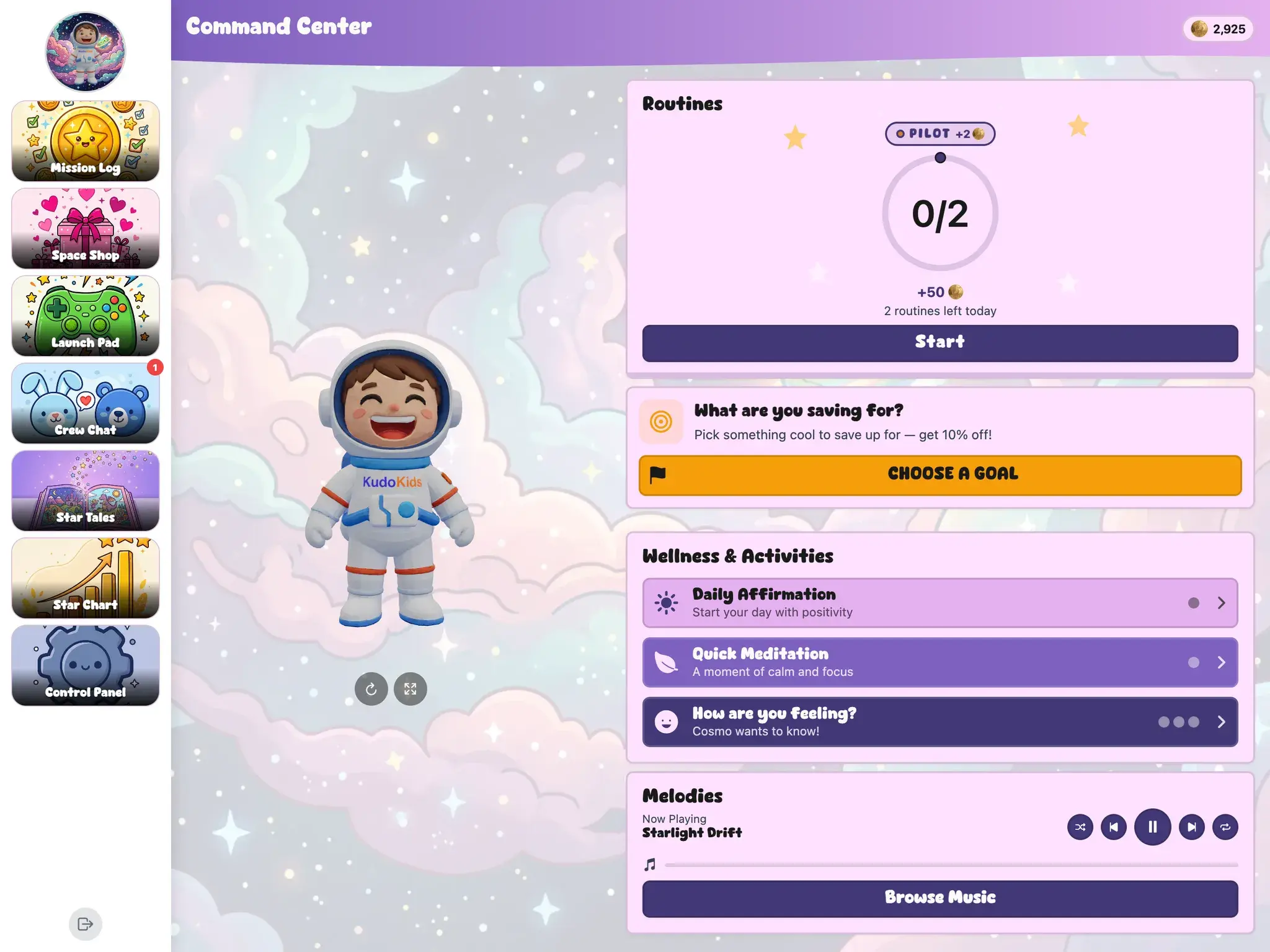
Tasks, Coins, Games — That's the Loop
Parents set routines and tasks
Chores, reading goals, wellness habits — configured once.
Kids earn Kudo Coins
Completed tasks earn coins. Educational games earn them back.
Screen time self-regulates
Fun games cost coins. No timers, no fights — kids budget themselves.
Tap any screen to see it full size.
Free plan available for families — tasks, games, wellness tools, and the parent dashboard cost nothing.
Before the feature list: three things that change for the child first, and what each one changes for the family you handed it to.
A kid who notices what somebody else needs
The child starts doing things that are for the household, not for themselves — clearing a table nobody asked them to clear. That isn't compliance. It's the beginning of noticing that other people in the room have needs.
Why this works
The child moves from being the person served to being a person who contributes, and the parent starts seeing them that way. That's a different relationship than the one where character is a subject the child is taught and a behavior the parent enforces — here they're both just running a household together, and the child's part is real.
A free way to make the contributing visible. The parent picks the responsibilities that serve the whole house, the child earns Kudo Coins by finishing them, and the parent approves — one tap, or a batch at the end of the day. The coins are earned from real life, not from playing. Free, whole, and there is no financial relationship anywhere in it: no commission, no affiliate link, nothing to disclose.
In a study of 9- to 14-year-olds, only routine household work that helped the whole family — setting the table, cleaning shared space — was associated with children's concern for others. Work that served only the child's own things was not. Grusec, Goodnow & Cohen, 1996, Developmental Psychology, 32(6), 999–1007.The child takes it on as their own
The child stops holding kindness and patience as rules somebody else enforces and starts holding them as things they actually believe — the difference between a kid who behaves when watched and a kid who has decided who they are.
Why this works
This is the one that ends the outsourcing. A parent who believes character gets delivered in an hour a week is a parent waiting on someone else to raise their child; the research points the other way — it runs through them. That reframes your own role too: not the supplier of a child's character, but the person who hands a parent something for the other 167 hours.
Something that puts the parent in the chair rather than the app. The parent sets what counts, the parent decides what the coins buy, the parent approves. Alongside the routines there are branching stories where a child's choices change the ending, with singalong songs and companion read-aloud — practice at choosing, with the meaning still supplied at home. All free. KudoKids is recommended by child-development experts, and it is not a curriculum and not a substitute for anybody's teaching.
A foundational review of how children take on their parents' values concluded that internalization depends on the child accurately reading the parent's message and accepting it — it runs through the parent-child relationship, not through exposure alone. Grusec & Goodnow, 1994, Developmental Psychology, 30(1), 4–19.View source →A kid who stops needing the reminder
The nagging stops because the child no longer needs it. What took a reminder in week one is just what they do now — and the thing a child does without being asked is theirs.
Why this works
The parent stops being the enforcement mechanism. Enormous amounts of affection get spent repeating instructions; when the repeating stops, the relationship gets that time back and the parent gets to be a parent rather than a foreman.
A free thing built to make repetition easy and worth it. The same routines come back every day; a growing library of learning games pays coins by score; a safe browser has no address bar and no search; friends stay off until a parent turns them on, and the parent chooses how new friends are approved — no real names, and a phone number or email physically cannot be sent. The repetition happens inside walls the parent didn't have to build.
Research on how habits form points to repetition in a stable context rather than intensity: in a real-world study of 96 adult volunteers, a new daily behavior repeated in the same context took a median of 66 days to become automatic, with wide variation (18–254 days). Lally, van Jaarsveld, Potts & Wardle, 2010, European Journal of Social Psychology, 40(6), 998–1009.View source →
These citations are the research behind how KudoKids is designed. The researchers and institutions named have not endorsed or evaluated KudoKids, and we make no claim about results for children who use it.
Apply as a family-ministry leader
Apply in two minutes. You'll sign a short Letter of Understanding — because community partners have no financial relationship with KudoKids, there's nothing to disclose. The thing you hand a family is the free app itself.
Want the detail?
Everything a careful reader wants to check, without cluttering the page for one who doesn't.
Everything that's in the app
You spend a few hours a month teaching kindness, responsibility, and patience — then families go home to evenings full of screens that reinforce none of it. KudoKids is a daily home tool that practices the same character language, and the free plan is the whole product, so sharing it is information, not an upsell.
It lives in the hours at home — practicing what you teach
The gap you can't reach is the everyday time at home. KudoKids fills it as daily practice: parents set the routines and tasks that matter this week, kids earn Kudo Coins by finishing them, and parents decide what the coins buy — including off-app screen time parents configure. The growth areas are the character language every tradition already teaches — kindness, responsibility, patience — with zero doctrinal content. It layers under your teaching; it never competes with it or replaces it.
The free plan is the whole product — nothing to administer, nothing to defend later
Free Explorer includes the routines and tasks, the full library of games, the wellness tools, the parent dashboard, and a first companion, Cosmo (the astronaut kid). Premium ($11.99/mo or $99.99/yr) only unlocks the other themed worlds, companions, backgrounds, and companion looks and extras, plus KudoKids AI, a parent-side setup assistant kids can never talk to; Premium never puts a wall in front of the learning and it is never purchase pressure on a child. Families sign up directly at kudokids.org — no site license, no procurement, no ministry account, and no child data ever reaches the congregation. It survives volunteer turnover because there's nothing to hand off.
What partners receive, and how to start
A Partner Listing
Your community listed alongside the therapists, educators, and families who recommend KudoKids — one voice among several, never the face of it.
Nothing to Disclose
No financial relationship, no affiliate link, no commission. Your ministry earns nothing and owes nothing — which is exactly what keeps the optics clean.
Reach the Founding Team
Questions from a parent workshop or a board member get a real human, not a support queue.
Apply
2-minute form.
Get Your Materials
Receive your Letter of Understanding and the materials to share.
Start Recommending
Introduce KudoKids to the families you work with.
Common Questions
No — KudoKids is faith-neutral by design. The character areas are ones every tradition teaches — kindness, responsibility, patience — with zero doctrinal content and nothing that contradicts what you teach. Faith communities are one audience among several who recommend it, alongside therapists, educators, and families. You supply the meaning; KudoKids just practices the habit at home.
Fair — and it's checkable in about ten minutes on the free plan. The growth areas are kindness, responsibility, and patience, with no doctrinal content. The framing to use: KudoKids is not a ministry product, so recommending it is information, like a community-resource flyer — not an endorsement, and not something that carries your congregation's authority.
You don't have to. Share it as information, the way you'd share any community resource. Community partners have no financial relationship with KudoKids — no affiliate link, no commission — so your ministry earns nothing and owes nothing. That's exactly what keeps the optics clean.
Premium exists ($11.99/mo or $99.99/yr) and we say so up front. The free plan isn't a teaser: it's the whole app — routines and tasks, the full library of games, the wellness tools, the parent dashboard, and a first companion — minus only the other themed worlds, companions, backgrounds, and companion looks and extras — and, for parents, KudoKids AI, the parent-side setup assistant. The upgrade decision sits with parents, never inside a child's game.
That story was surveillance of congregants. KudoKids is the opposite: the parent dashboard gives parents visibility into their own child's progress, there is no ministry console, no child data ever reaches the congregation, and there's no commission arrangement for anyone to find.
Families already have screens — the question is what the time does. KudoKids makes it earned (coins come from real-life routines and tasks) and growth-oriented, and coins can buy off-app device time parents configure — so it often shifts time off the screen, not onto it.
Ready to partner with KudoKids?
Apply in 2 minutes. Sign your Letter of Understanding and start recommending KudoKids to the families you serve.