First-time parents ask about screens. Now you can answer.
Safe screen time for kids 3–12 that instills growth — routines-first, so it extends the habits you teach instead of contradicting them. KudoKids never shows ads in the app or sells child data, it's free for every family, and there's nothing for you to run, buy, or disclose.
- Free for every family
- No ads*
- No child data sold
- Nothing for you to run or disclose
*ads can be shown via the YouTube and web browser features if a parent turns them on.
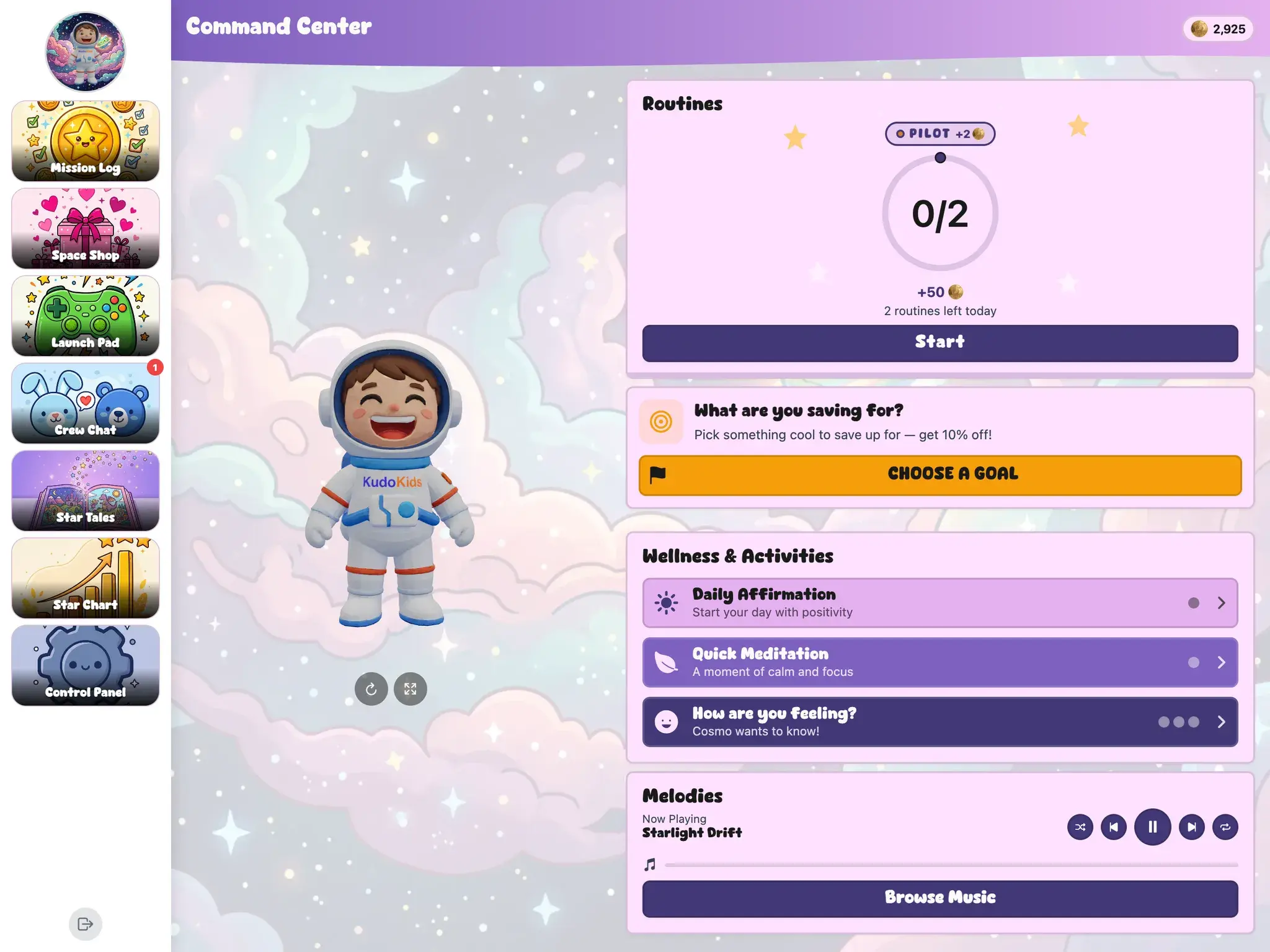
Tasks, Coins, Games — That's the Loop
Parents set routines and tasks
Chores, reading goals, wellness habits — configured once.
Kids earn Kudo Coins
Completed tasks earn coins. Educational games earn them back.
Screen time self-regulates
Fun games cost coins. No timers, no fights — kids budget themselves.
Tap any screen to see it full size.
Free plan available for families — tasks, games, wellness tools, and the parent dashboard cost nothing.
Three things you already watch for in your room — and what a family gets to take home for them.
The child who knows what comes next
A four-year-old who knows the shape of her evening — dinner, bath, two books, lights out — walks into your room on Monday as a different child than one whose nights get improvised. You can see which is which in the first ten minutes of drop-off.
Why this works
The first-time parent who keeps asking what home is supposed to look like stops guessing and starts running a rhythm that matches yours — so what you build between 8 and 5 doesn't come undone by 7.
Every routine and task, the Kudo Coins kids earn for finishing them, and the parent's say over what those coins buy — including off-app device time the parent sets themselves, with a countdown — is free to every family.
Family routines established during the preschool years predicted better school readiness at kindergarten across 3,250 children. Ferretti & Bub (2017), Early Education and Development 28(1), 59–77.View source →Words before the meltdown
The three-year-old who bites doesn't have a word yet for "I wanted that." Watching a child cross from grabbing to saying it is the biggest thing that happens in a preschool room — and it doesn't stop happening at 5:30, it just stops being watched.
Why this works
The parent who can't ask "how was your day" without getting a shrug finally has a way in, so the language you build at circle time keeps going at the kitchen table.
The daily check-in is free — never scored, never graded, with the companion answering warmly — and so is the comfort flow afterward, where a child can breathe, sit through a short meditation, or just stay with the companion for a minute.
In 143 children assessed at ages 3 to 4, emotional competence predicted social competence both at the time and later in kindergarten. Denham et al. (2003), Child Development 74(1), 238–256.View source →Small jobs, real capability
The three-year-old who insists on carrying his own plate is telling you exactly what he needs. Children who get real jobs instead of pretend ones stand differently in your room — and most of them only get the pretend ones once they're home.
Why this works
The first-time parent who does everything for their child because it's faster hears from you that it's worth the extra four minutes, and gets a way to actually do it — so their child gets to be as capable at home as he is with you.
Real tasks and real responsibilities, coins earned for finishing them, and a parent side where approval is one tap or a batch — free, with nothing to buy to make it work.
Among 9,971 children, those who did household chores in kindergarten reported higher academic, peer-relationship, prosocial, and life-satisfaction competence by third grade. White et al. (2019), Journal of Developmental & Behavioral Pediatrics 40(3), 176–182.View source →
These citations are the research behind how KudoKids is designed. The researchers and institutions named have not endorsed or evaluated KudoKids, and we make no claim about results for children who use it.
Apply as a childcare director
Apply in two minutes to get your safety facts sheet, a printable parent-night handout, and a partner listing. You'll sign a short Letter of Understanding — on the education track there's no financial relationship and nothing to disclose.
Want the detail?
Everything a careful reader wants to check, without cluttering the page for one who doesn't.
Everything that's in the app
First-time parents ask you what home time should look like — and for screens, most "educational" apps only add watch time you would never endorse. KudoKids is the routines-first exception, and the free plan is the real product, so the recommendation never becomes an upsell to your families.
It carries your routines home — it doesn't add screen hours
You spend tours talking about hands-on, independence-building learning; you can't hand families a link to more watch time without undercutting your own brand. KudoKids works the other way. Kids earn Kudo Coins by finishing the same real-world routines your classroom builds — getting dressed, brushing teeth, tidying up — and parents decide what coins buy, including the off-app screen time they configure. The reward loop starts off-screen by design, so a recommendation stays on-mission.
It passes a director's safety check in minutes
Before you say a word to a family, open a free account and check every line yourself. KudoKids is built the opposite way from most of what's already on parents' tablets, and none of it takes your word for it — no card, no demo call, no committee.
*ads can be shown via the YouTube and web browser features if a parent turns them on.
The free plan is the whole product — so it's a handout line, not a program to run
Free Explorer includes the routines and tasks, the full library of games, the wellness tools, the parent dashboard, and a first companion, Cosmo. Premium ($11.99/mo or $99.99/yr) is a parent's choice that unlocks the other themed worlds, companions, backgrounds, and companion looks and extras — plus, for parents, KudoKids AI, a setup assistant that drafts routines and rewards for their approval; kids can never talk to it. Premium never walls off the learning, and it is never pressure on a child. No center login, no classroom dashboard, no student data, and nothing for you to procure or get through licensing. Families sign up directly at kudokids.org; your total lift is one line in a newsletter.
What partners receive, and how to start
A One-Page Safety Facts Sheet
Plain-language answers to every safety question a parent asks — ready for your files and ready to hand a family.
A Printable Parent-Night Handout
A brand-clean handout and a newsletter line you can forward, print, or drop in a graduation packet as-is.
A Partner Listing
Your program listed as a KudoKids education partner — recognition for pointing families to something you vetted.
Nothing to Disclose
The education track has no financial relationship with KudoKids — no affiliate link, no commission. It stays a resource, not marketing.
Reach the Founding Team
Questions from your desk get a real human, not a support queue.
Apply
2-minute form.
Get Your Materials
Receive your Letter of Understanding and the materials to share.
Start Recommending
Introduce KudoKids to the families you work with.
Common Questions
KudoKids works with the home screen time already happening and points it back at the real world. Coins are earned by doing real tasks and routines, and when coins buy device time, it's only time a parent deliberately set aside — a companion that makes a kid earn it, one routine at a time. That's the routines-and-habits answer your program already stands for, extended past pickup.
It's built for ages 3–12. At the youngest ages it's routines done alongside a parent — which matches the co-use guidance you already give families — plus calm-down and sleep tools. And it grows with the family through elementary school and older siblings, so it's one answer that lasts long past graduation.
You won't be. The education-partner track has no financial relationship — no affiliate link, no commission, nothing to disclose. It's a resource on a parent handout, exactly like a book list. Families sign up directly with KudoKids, and the core app is free to use.
Fair caution. Here the free plan is the whole product — routines, the full library of games, the wellness tools, the parent dashboard, and a first companion — so there's no auto-renew trap waiting for families and no upsell riding on your recommendation. KudoKids is founder-funded, with a stated commitment to keep the core app free for every family. Premium is a parent's choice, never pressure on a child.
Nothing to run. No center login, no classroom dashboard, no daily posting, no student data, and nothing for you to procure or send to licensing. It lives at home, run by parents. Your total lift is one line in a newsletter or one handout at pickup.
Not yet — it's a young product. What exists today: it's recommended by child-development experts, and the safety practices are stated plainly enough to check against your own vetting in minutes. We'll give you a one-page facts sheet for your files.
Ready to partner with KudoKids?
Apply in 2 minutes. Sign your Letter of Understanding and start recommending KudoKids to the families you serve.