The Short Answer
A chore chart fails when the newness runs out before a habit forms. After the stickers stop being exciting, the chart only works if a parent checks it every day, and one list can't fit a 5-year-old and a 9-year-old. What tends to last is one small job per kid, tied to a daily moment, paid the same day.
What Are the Signs a Chore Chart Is Failing?
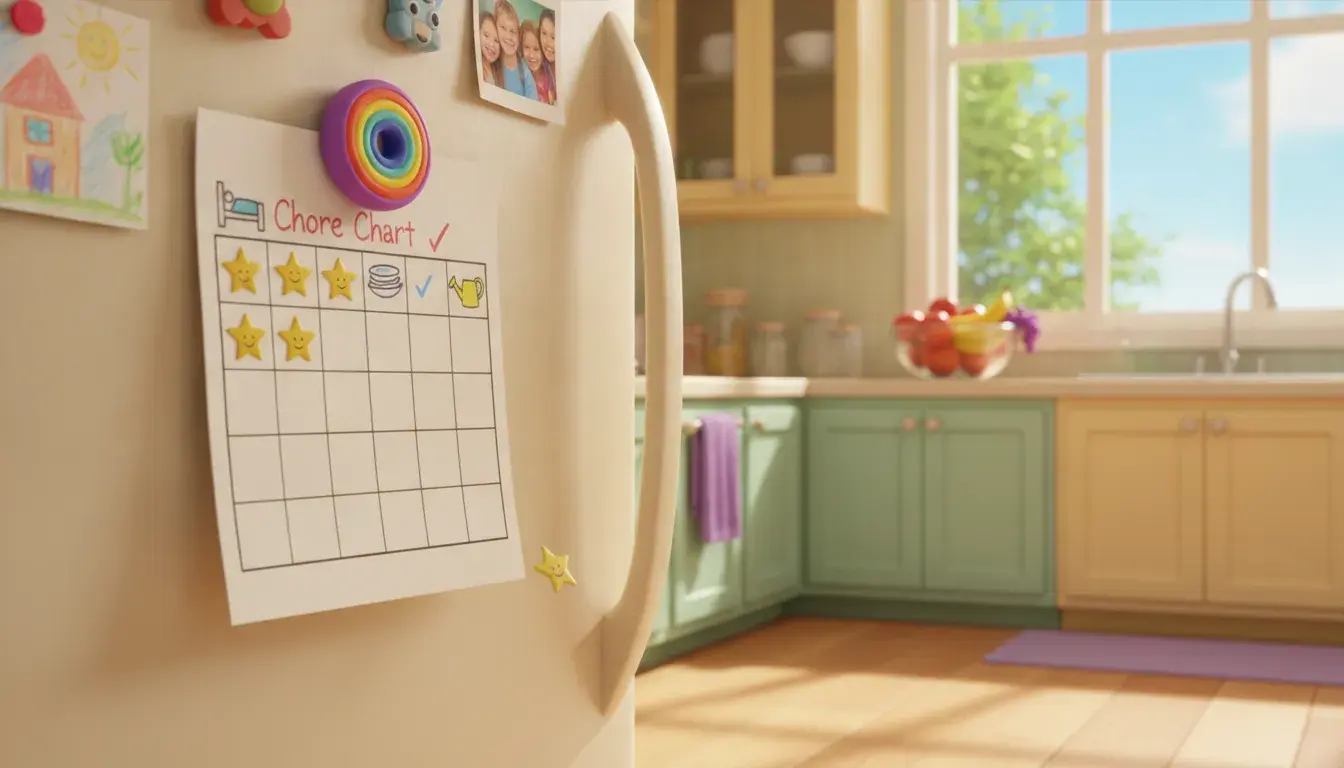
Three signs a chore chart is failing: kids stop marking jobs, you start reminding, and nobody looks at the chart anymore. Say you print a chart on Sunday night. The first week is great: everyone wants a sticker, and the younger one reminds you. By week two, you're the one reminding. By week three, the chart is still on the fridge, but nobody is looking at it, and you're back to asking four times.
A paper chart has a few built-in weak spots, and in a house with more than one kid, they show up faster.
| What breaks | What you notice | What to change |
|---|---|---|
| The novelty wears off | Stickers stop being exciting | Tie each job to a moment that already happens every day |
| It runs on your memory | A couple of missed days, and the chart becomes "optional" | Let each kid mark their own job; you check and approve |
| One list for every kid | The older one is bored, the younger one is lost, both say "not fair" | One list per kid, matched to their age |
| Too many jobs at once | A strong start, then overwhelm | Start with one job; add the next when the first is automatic |
| The payoff is too far away | "On Friday" feels like forever to a 5-year-old | Pay out the same day |
| Stars get taken away | A bad afternoon turns into a fight about the chart | Never take back what they earned |
Whether reward charts work at all is a separate question, covered in do reward charts work? This post is about why a chart that worked in week one quits a few weeks later.
Is It Just the Novelty Wearing Off?
Novelty is part of it. The newness of a chart runs out long before a habit forms, and nothing takes its place.
A habit is something you do automatically when a familiar moment comes around, without having to decide. A 2012 review in the British Journal of General Practice by Gardner, Lally, and Wardle sums up the research: habits form by repeating the same action in the same situation. In the team's study, adult volunteers each took on one new daily behavior. On average, it took 66 days to feel as automatic as it was going to get, and people varied widely. Simple actions became automatic faster than longer routines. And missing the occasional day didn't seriously set people back.
Stickers can carry a chart for the first week or two. In that study, a habit took closer to two months. For the weeks in between, nothing is holding the routine up except you.
It also explains why "21 days to form a habit" doesn't match what you're seeing. The same review traces that number to anecdotes about plastic surgery patients getting used to their new appearance, not to habit research.
What helps: attach the job to something that already happens every day. "Right after breakfast, plate on the counter." "As soon as you're home, backpack on the hook." The moment reminds them, so you don't have to. And keep the first job small, because simple actions stick faster.
Why Does the Chart Depend on a Parent Remembering?
A paper chart depends on a parent because it can't remind anyone. Somebody has to remember to check the room, put the sticker on, buy more stickers, count up on Friday, and hand over the reward. That somebody is often one parent: in the study below, women did more of the anticipating and checking.
Sociologist Allison Daminger calls this kind of work cognitive labor. Her 2019 study in the American Sociological Review was based on 70 interviews with members of 35 couples. She describes cognitive labor as four steps: seeing what the household needs, working out the options, deciding, and checking how it's going. She found it tiring and often invisible, even to the person doing it.
A chore chart adds a new stack of that work, every day, to whoever put it on the fridge. When that parent has a hard week and misses two days, the kids learn the chart is optional.
What helps: move the remembering off your plate. Let each child mark their own job done (a magnet, a checkbox, a tap), and make your part a quick look and a yes.
Why Does One Chore Chart Fail With Multiple Kids?
One chore chart fails with multiple kids because it asks two different kids to live by one list. Give a 9-year-old and a 5-year-old the same jobs and the 9-year-old is bored while the 5-year-old can't keep up. Give them different jobs on the same chart and someone says "not fair" by Wednesday.
Different lists are fine as long as you explain them. In a 2004 study in the Journal of Family Psychology, Kowal, Krull, and Kramer looked at 74 families with adolescent siblings. Parents treating siblings differently was linked with worse parent–child relationships only when the kids saw it as unfair. Different treatment that kids saw as fair wasn't linked with worse relationships, and the authors encourage families to talk through the reasons. The study was of teenagers, so take it as a pointer for younger kids, not proof.
Here's what fair can look like in a house with two kids:
| A 5-year-old | A 9-year-old | |
|---|---|---|
| Their job | Shoes by the door when they get home | Unload the dishwasher after school |
| How it's marked done | A picture card they flip, or a tap on a screen | They mark it; you check it |
| When the payoff comes | Right away, the same day | Same day, with the option to save up for something bigger |
| What you say out loud | "This is your job because you're five." | "Yours is harder because you're nine, and it pays more." |
Need ideas for each age? Our guide to age-appropriate chores from 3 to 12 goes year by year.
Does Taking Stars Away Make It Worse?
Taking stars away can make a chart worse, and the CDC tells parents not to do it. A chart where a star comes off for hitting your brother can turn into a running score of every bad day, and kids can stop caring about a chart that goes backward. (We look at the research in are behavior points and demerits bad for kids?)
The CDC's guidance on praise and rewards for ages 2 to 4 (2026) says: "Never take away rewards your child has earned." The same page says to give the reward "immediately after the child does the behavior." Keep consequences for behavior separate from the chart. If a job was done badly, the fix is "let's try that again," not a deduction.
How Do You Make a Chore Chart Work Long Term?
To make a chore chart last, start over smaller: one job per kid, tied to a daily moment, paid the same day, for about two months. If the chart on your fridge has already quit, here's how:
- Take the old chart down without a speech. "We're trying something simpler" is enough.
- Pick one job per kid, matched to their age. Just one to start.
- Tie it to a moment that already happens. After breakfast, after school, before bath.
- Let the kid mark it done. You check and say yes. That way you're not the one reminding.
- Pay out the same day, and never take it back. A sticker, a coin, a few minutes of something they chose.
- Add the second job only when the first happens without reminders. Expect that to take weeks.
- Plan on about two months. A missed day isn't a reset. Pick it back up the next day.
Is a Chore App Better Than a Paper Chart?
A chore app isn't automatically better than a paper chart. A paper system that follows the steps above can work well. An app can do two things paper can't: keep each kid's balance without anyone counting stickers, and pay out the moment you approve a job.
When we built KudoKids (kudokids.org), we designed around what kills charts in houses with more than one kid. Each child gets their own tasks, each with its own Kudo Coin value, so the 5-year-old and the 9-year-old are never on the same list. Kids tap a job done, and parents choose which jobs need their sign-off. KudoKids is set up for earning: nothing is docked automatically, and the demerit buttons are off unless you turn them on. A job that wasn't really done gets a "try again," not a penalty. If a parent marks an already-approved job incomplete, that job's coins are taken back. What kids earn, they can spend on things you've priced, like real screen time, or save toward something bigger. Here's how a chore app set per kid works.
If you're rebuilding from scratch, here are reward system ideas for kids that last past week two.
Frequently Asked Questions
How long does a chore chart usually last?
We couldn't find a study that measured how long home chore charts last. The habit research did find, in adult volunteers, that a new daily routine took about two months on average to feel automatic. If your chart died before then, the stickers were doing the work and nothing took over when they stopped being new.
Should siblings have the same chores?
Siblings of different ages shouldn't have the same chores. Match each child's jobs to their age, and explain the difference out loud. In a 2004 study of teenage siblings, different treatment was linked with worse parent–child relationships only when the teens saw it as unfair.
What if my kid says they don't care about the reward?
Ask what they would work for, and let them pick from a short list that includes time with you and privileges, not just stuff. If they still don't care, the job may be too big or too far from a daily moment. Shrink it and tie it to one, then try again next week.
What if my child marks a chore done without doing it?
Add a quick check before the reward goes through. If it wasn't done, send it back with a "try again" rather than taking away anything they already earned.
Should I give up on rewards if the chart failed?
One failed chart isn't a reason to give up on rewards. They work best for routines a child doesn't do on their own yet. If the chart failed, check the setup first: one list for every kid, no daily moment, or one parent doing all the remembering.
Last updated: September 24, 2026
This article is for informational purposes only and does not constitute professional medical, psychological, or educational advice.