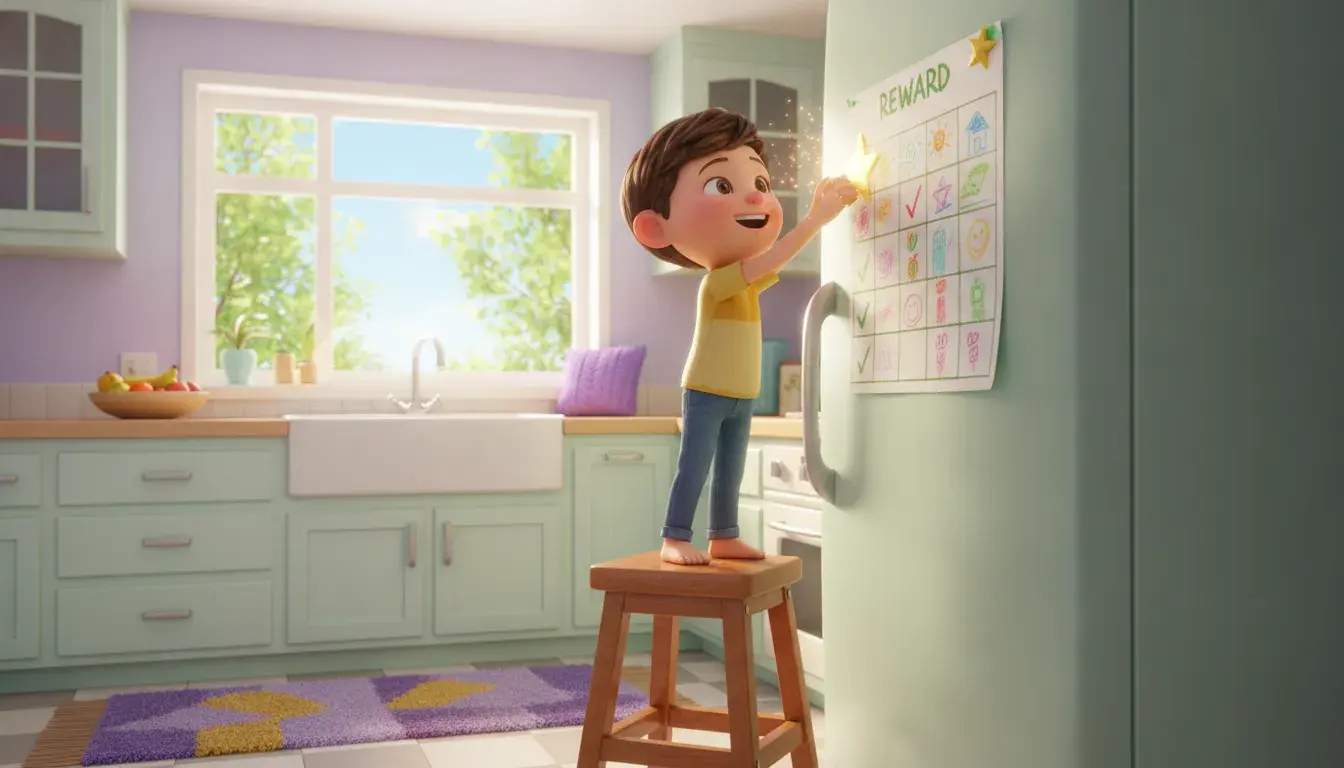
The Short Answer
Yes, for the right job. A reward chart works best for a routine your child doesn't do on their own yet, like getting dressed or brushing teeth. The reward should come quickly and never be taken away. It can backfire on things a child already loves doing. And two kids of different ages need their own lists.
What Does the Research Say About Reward Charts?
Rewards can lower a child's interest in things they already enjoy, but in lab studies they didn't lower interest in dull tasks. So whether a chart helps depends on the job.
Rewards can shrink a child's interest in something they already enjoy. A well-known 1973 Stanford study by Lepper, Greene, and Nisbett worked with preschoolers aged about 3 to 5 who already liked drawing. The kids were split into three groups. One group was promised a "Good Player Award" for drawing. One got the same award as a surprise afterward. One got nothing. One to two weeks later, in ordinary free play, the kids who had been promised the award spent about half as much free time drawing as the other two groups. That was 8.6% of their free time, against 18.1% for the surprise group and 16.7% for the kids who got nothing. Researchers call this the overjustification effect: once a fun activity becomes a way to earn a prize, kids may do less of it when the prize stops.
A 1999 review of 128 experiments in Psychological Bulletin by Deci, Koestner, and Ryan found the same pattern across studies. Expected, tangible rewards lowered interest in the activity. The drop tended to be bigger in children than in college students. Praise and positive feedback went the other way and raised interest in college students. For children, the boost was so small it may have been chance, the same authors reported in 2001.
Rewards don't take away interest that was never there. In a 2001 follow-up in Review of Educational Research, the same researchers looked at dull tasks on their own. Rewards did not lower interest in them, because there was little interest there to lose. Rewards didn't make dull tasks more interesting either. For a dull task, the authors say, what matters over time is a child understanding why the job matters, so they start doing it on their own.
Chores like emptying the dishwasher usually belong in that second group: a 6-year-old isn't doing them for fun. There, a reward can get the routine going while the habit forms and your child learns why it matters.
Reward Charts Pros and Cons: When Do They Help or Backfire?
Reward charts help most with routines your child doesn't do yet. They backfire most on things your child already loves, or already does to be kind.
| Situation | What the research found | Source |
|---|---|---|
| A routine your child doesn't do yet (teeth, getting dressed, a chore) | In lab studies, rewards didn't lower interest in dull tasks, and didn't raise it | Deci et al., 2001 |
| Something your child already loves (like drawing) | A promised prize cut later free-time drawing by about half | Lepper et al., 1973 |
| Helping they already do on their own | Toddlers given a material reward for helping helped less afterward; toddlers given praise did not | Warneken & Tomasello, 2008 |
| Praise for being smart ("you're so clever") | After a setback, kids gave up sooner and enjoyed the task less | Mueller & Dweck, 1998 |
| Praise for effort ("you kept at it") | Kids kept going after a setback | Mueller & Dweck, 1998 |
| A reward given right after the behavior | Recommended for ages 2 to 4 (guidance, not a study) | CDC, 2026 |
In a 2008 study of 20-month-olds, toddlers who got a physical prize for helping an adult were less likely to help again than toddlers who were thanked or given nothing. So be careful about paying for kindness your child already shows on their own. And in six studies with fifth graders, children praised for being smart cared more about looking smart than about learning, and after a hard problem they kept trying less than children praised for effort. So what you say when you hand over the sticker matters too.
Is a Reward Chart Just Bribery?
A reward chart isn't bribery if the deal is set ahead of time. The difference is timing, and who sets the terms.
| Reward | Bribe | |
|---|---|---|
| When it's agreed | Ahead of time, when everyone is calm | In the middle of a meltdown |
| When it's given | After the job is done | Before, to make the behavior stop |
| What your child learns | "Doing the job gets me something" | "Escalating gets me something" |
| Who sets the terms | You, in advance | Whoever is loudest right now |
"When your shoes and backpack are put away, you earn your coin" is a reward. "If you stop screaming, you can have a cookie" is a bribe, and it teaches that screaming works.
Lepper added one more piece of advice in his 1973 final report on a federal research grant: use rewards only where they're needed to get the behavior going, and use the smallest reward that does the job. A reward chart shouldn't be the reason a child does everything. It's for the few routines that aren't happening yet.
What Makes a Reward Chart Work?
A reward chart works when it targets one or two clear behaviors, pays out right away, and never goes backward. The CDC's guidance on praise and rewards (2026) is written for ages 2 to 4. Here's how to use it:
- Pick one or two specific behaviors. The CDC says to "pick a couple of specific behaviors." Say what done looks like: "backpack on the hook," not "be responsible."
- Pay out right away. The CDC says the reward should come "immediately after the child does the behavior." A prize on Saturday for Monday's effort is too far away for a young child to connect.
- Never take an earned reward away. In the CDC's words: "Never take away rewards your child has earned." Once a chart can go backward, a bad afternoon can turn into a fight about the chart. (We look at the research on whether taking points away backfires.)
- Reward often at first, then move on. The CDC suggests rewarding often when you start. Once the behavior is regular, switch the chart to a new behavior you'd like to see more of.
- Praise the effort out loud. Say what they did: "You remembered without me asking." In the fifth-grade studies above, kids praised for effort kept trying longer after a setback than kids praised for being smart.
- Let them help choose the rewards. The CDC calls extra time with you or a special activity "a powerful reward for young children," and says kids get tired of some rewards, so change the list over time. Older kids can save toward something bigger.
Can Siblings of Different Ages Share One Reward Chart?
Siblings of different ages can share one system, but not one list. A single chart assumes both kids want the same things, can do the same jobs, and can wait the same amount of time. A 5-year-old and a 9-year-old can't.
| A 5-year-old | A 9-year-old | |
|---|---|---|
| Jobs worth rewarding | One or two small steps: shoes by the door, plate to the counter | Bigger jobs: unloading the dishwasher, packing tomorrow's bag |
| When the reward shows up | The same day, ideally right away | Can save up toward something later in the week or month |
| What rewards look like | Small and frequent | Fewer, bigger, and chosen by them |
| What "fair" means | "I got mine too" | "My jobs match my age, and my rewards do too" |
Fair here means each child works at their own level, and both know why the lists are different. Say it plainly: "Your list is different because you're different ages. When you're nine, yours will look like this too." (For bedtimes, screen time and the "not fair" talk, see different rules for siblings of different ages.)
In KudoKids (kudokids.org), each child gets their own tasks, each with its own Kudo Coin value. A 5-year-old can earn for shoes by the door while a 9-year-old earns for the dishwasher, and neither is stuck on the other's chart. A speaker button reads each routine and step aloud, so a child who can't read yet can follow along. KudoKids is set up for earning: nothing is docked automatically, and the demerit buttons are off unless a parent turns them on. Here's what a sticker chart set per kid looks like.
For setups that hold up in a real house, see reward system ideas that last past week two.
Frequently Asked Questions
Are reward charts bad for kids?
Not when they're used for routines a child doesn't do on their own yet. The research warns about two things: promising prizes for activities a child already enjoys, which can shrink that enjoyment, and paying for helping they already do. Praise the effort, pay out quickly, and never take earned rewards back.
Do sticker charts work for toddlers?
They can. The CDC's guidance for 2- to 4-year-olds suggests a picture chart, a couple of specific behaviors, and a reward given right away. At this age, putting the sticker on while you cheer can be reward enough.
What if my child stops caring about the chart?
That can mean the newness wore off before the habit formed, or the chart depends on you remembering. Tie the job to a moment that already happens, like right after breakfast, and pay out the same day. We go through the fixes in why chore charts stop working after a few weeks.
Do reward charts work for older kids?
They can, if the chart changes as they grow. Swap stickers for points toward a goal they chose, let them help set what each job is worth, and give bigger jobs bigger payoffs. A 10-year-old who helped build the reward list has a reason to use it.
How long should you use a reward chart?
There's no set number of weeks. The CDC suggests rewarding often at first, then changing the chart to a new behavior once the first one is happening regularly. Habits take a while to form: in a study of adult volunteers, a new daily habit took about two months on average to feel automatic, with big differences between people. So don't pull the chart the first week it seems to be working.
Do reward charts work for kids with ADHD?
They can, as one part of a wider plan. The American Academy of Pediatrics' 2019 ADHD guideline strongly recommends parent training in behavior management as the first treatment for 4- and 5-year-olds, and calls behavioral parent training well established for children before adolescence. That training teaches parents to set up and follow through on rewards and consequences at home. Work with your child's clinician on the details.
Last updated: September 24, 2026
Note: References to ADHD are informational only. If you suspect your child has ADHD, consult a qualified healthcare professional.
This article is for informational purposes only and does not constitute professional medical, psychological, or educational advice.